What Is Clean vs Sterile? A Practical Home Guide
Explore the difference between clean and sterile environments, why it matters for health, and practical steps to achieve each at home. A data-informed guide by Cleaning Tips.


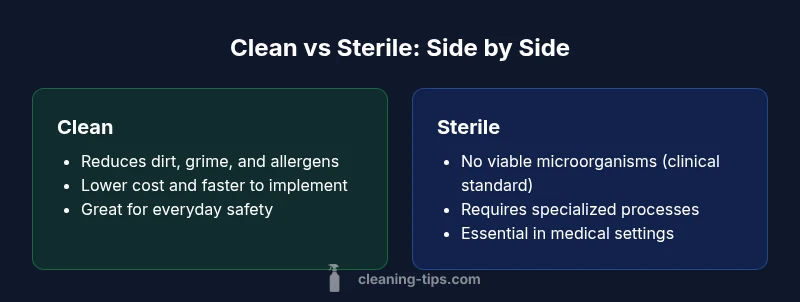
Short answer: Clean means removing visible dirt, grime, and residues to improve appearance and reduce allergens; sterile means absence of viable microorganisms, achieved only with clinical-grade processes. For most homes, aim for cleanliness and regular disinfection on high-touch surfaces, while reserving sterile methods for medical or lab tasks. According to Cleaning Tips, this balance keeps spaces safe without overkill.
What clean means in everyday settings
In the everyday sense, clean refers to surfaces and spaces that look, feel, and smell free of visible dirt and residues. It is about reducing grime, dust, and sticky residues so that a room feels fresh and safe. When people ask what is clean vs sterile, they are comparing a practical standard (clean) to a biological one (sterile). According to Cleaning Tips, cleanliness prioritizes the removal of dirt and allergens that affect comfort and health, rather than achieving a surgical-grade absence of all organisms. In households, a regular routine of cleaning with appropriate products typically yields a comfortable, healthy environment without requiring clinical-grade equipment. This approach aligns with consumer realities: you can maintain a clean home using common cleaners, microfiber cloths, and a consistent schedule.
What sterile means and where it's required
Sterile describes a state in which no viable microorganisms remain on a surface or in a space. This level of microbial control is achieved through validated processes such as autoclaving, sterile filtration, and the use of sterilants approved for medical or lab use. In practice, sterile conditions are essential in operating rooms, pharmaceutical manufacturing, and certain food-processing environments. For homes, sterile environments are rarely required for daily activities. The Cleaning Tips team emphasizes that home safety is better served by regular cleaning paired with targeted disinfection on high-touch areas, rather than attempting true sterility in ordinary rooms.
The core differences: scope, methods, and outcomes
The distinction between clean and sterile hinges on three axes: scope, methods, and outcomes.
- Scope: Clean aims to remove visible dirt and reduce substances that affect comfort; sterile aims to eliminate viable microorganisms entirely.
- Methods: Cleaning uses detergents and scrubbing; disinfection reduces microbial load; sterilization uses high heat, chemical sterilants, or radiation.
- Outcomes: Clean improves appearance and general safety; sterile yields a biological condition suitable for invasive procedures or sterile packaging.
In everyday life, the first two steps (cleaning and disinfection) are often sufficient, while sterilization is reserved for specialized contexts.
Health implications: pathogens, allergies, and consumer reality
A thorough cleaning routine lowers the amount of dust and residues that trigger allergies and irritation. Disinfection further mitigates the risk of surface-borne pathogens on high-touch areas like door handles, countertops, and light switches. However, consumers should recognize that achieving true sterility in a typical home is neither practical nor necessary for most daily activities. By framing cleanliness as a continuum—from basic cleaning to targeted disinfection—households can balance health goals with safety and convenience. The Cleaning Tips guidance emphasizes proportionate steps: clean regularly, sanitize where needed, and use products as directed, paying attention to compatible surfaces and proper ventilation.
Achieving clean conditions at home: a practical guide
A reliable home-cleaning routine starts with a plan and the right tools. Begin with a surface-by-surface inventory: kitchens, bathrooms, living areas, and frequently touched zones. Use detergent-based cleaners to remove grime, then follow with a disinfectant on high-touch surfaces such as faucet handles, light switches, and smartphone screens. Always read product labels for surface compatibility and required contact times. Microfiber cloths capture more dirt with less chemical waste, and rotating cleaners helps prevent residue buildup. Regular maintenance—daily quick wipes, weekly deeper cleans, and monthly surface refreshes—builds a durable standard of cleanliness without turning your home into a sterile laboratory.
Disinfection vs cleaning: when to disinfect and how
Disinfection is a targeted step after cleaning when you want to lower microbial load on specific surfaces. Choose EPA-registered disinfectants appropriate for the surface type, follow the label for contact time, and avoid mixing products that can release hazardous gases. For households, prioritize bathrooms, kitchens, and entryways for disinfection after events like cooking, illness, or pet care. If you manage a home with vulnerable occupants (young children, elderly, or immune-compromised individuals), consider a slightly higher level of vigilance on high-touch areas, but still within practical limits.
Common misconceptions and myths about cleanliness
Common myths include the belief that more aggressive chemical use always means safer spaces, or that sterile conditions are feasible in ordinary kitchens. In reality, improper use can cause skin irritation, respiratory irritation, or chemical exposure without providing meaningful benefits. Another misconception is that cleaning alone is enough to prevent all infections; while cleaning reduces dirt, disinfection on critical surfaces is essential in reducing microbial load. A balanced approach—cleaning first, then selective disinfection—offers practical protection without unnecessary risk or cost.
When sterile conditions matter: kitchen, bathroom, and medical-grade spaces
Sterile conditions matter most in environments where any microbial presence could lead to serious harm: certain medical spaces, sterile pharmaceutical processes, or labs handling pathogens. In kitchens and bathrooms, clean and disinfect strategies substantially reduce risk, but true sterility is not required for routine food prep or personal care areas. The goal is to minimize risk through consistent cleaning, proper hand hygiene, and responsible use of disinfectants, rather than chasing an unattainable standard of sterility in every room.
Building a sustainable cleaning routine: long-term strategies
Sustainability in cleaning means integrating habits that fit daily life and respect health and safety. Create a calendar: daily quick cleanups, weekly deeper cleans, and monthly surface checks. Use refillable cleaners or low-toxicity formulas when possible, improve ventilation to reduce chemical exposure, and store all cleaners safely away from children and pets. Track your progress with a simple checklist and adjust products as needed to match changing household needs. A steady routine reduces the perception of risk and supports a healthier home over time.
Comparison
| Feature | Clean (Home standard) | Sterile (Clinical standard) |
|---|---|---|
| Definition | Visible dirt removal and residue reduction; comfort-focused | No viable microorganisms present; biology-focused |
| Typical Uses | Daily household surfaces and spaces | Operating rooms, labs, sterile packaging, certain foods facilities |
| Methods | Cleaning with detergents; optional disinfection on high-touch areas | Autoclaving, chemical sterilants, validated sterilization processes |
| Time & Cost | Low to moderate; routine supplies and schedules | High; specialized equipment, training, validation |
| Best For | Reducing grime, dust, and allergens for safe living spaces | Achieving true absence of viable microorganisms for high-risk contexts |
Strengths
- Lower upfront effort and cost for daily life
- Easily integrated into regular routines
- Reduces visible dirt and allergens
- Sufficient for most household health goals
- Minimizes chemical exposure when used properly
Weaknesses
- Sterile-grade practices are unnecessary for typical homes
- Disinfectants can leave residues or cause sensitivities
- True sterility requires equipment, training, and strict protocols
Clean is usually the practical default for homes; sterile conditions are reserved for clinical or highly controlled settings.
For ordinary households, prioritize cleaning and targeted disinfection on high-touch surfaces. Reserve sterile procedures for medical or laboratory contexts to avoid unnecessary costs and risk.
Questions & Answers
Is cleaning the same as sanitizing?
No. Cleaning removes dirt and grime, while sanitizing reduces microbes to safe levels; sanitizing is a subset of cleaning that targets microbiological load. You often sanitize high-touch surfaces after cleaning.
Cleaning removes visible dirt first, then sanitizing reduces germs on the surface. Use both steps in sequence on high-touch areas.
What does sterile mean in practice?
Sterile means no viable microorganisms remain, typically achieved with specialized processes in medical or lab settings. In everyday life, sterility is rarely required outside those contexts.
Sterile means no living germs remain, usually only in clinics and labs.
Can I achieve sterility at home for everyday tasks?
No for everyday tasks; true sterility requires controlled equipment and protocols. For home use, cleaning plus disinfection on high-touch surfaces is sufficient.
Sterility at home isn’t practical; cleaning and disinfection are usually enough.
Do I need sterile conditions in the kitchen?
No; while hygiene is important, sterile conditions are not necessary for typical cooking. Focus on cleaning, hand hygiene, and sanitizing high-touch areas.
A sterile kitchen isn’t needed; clean well and sanitize the places you touch most.
How long should surfaces stay wet when disinfecting?
Follow the product label; typical contact times range from 30 seconds to several minutes. Always adhere to the label instructions for safe and effective use.
Check the label for how long the product should stay wet on the surface.
What are common mistakes when cleaning vs sterilizing?
Assuming cleaning alone kills germs; mixing incompatible products; not allowing required contact times; recontaminating surfaces after cleaning.
Don’t mix cleaners or skip contact times; clean first, then disinfect properly.
The Essentials
- Develop a consistent cleaning schedule for all living spaces
- Disinfect high-touch surfaces after meals, illness, or pet care
- Sterility is not required for home environments
- Use proper product labels and avoid mixing cleaners
- Aim for a practical balance of cleanliness and safety