Clean vs Sterile Technique in Home Cleaning
Explore clean vs sterile technique in home cleaning. Learn definitions, practical steps, and when to apply each method for a safer, healthier home environment.


Clean technique is the practical default for most household tasks, offering reliable results with readily available supplies. Sterile technique adds a higher level of asepsis and is typically reserved for high-risk tasks, like handling raw foods or medical-like surfaces. For home use, prioritize consistent cleaning and disinfection over formal sterile protocols.
Defining clean vs sterile technique
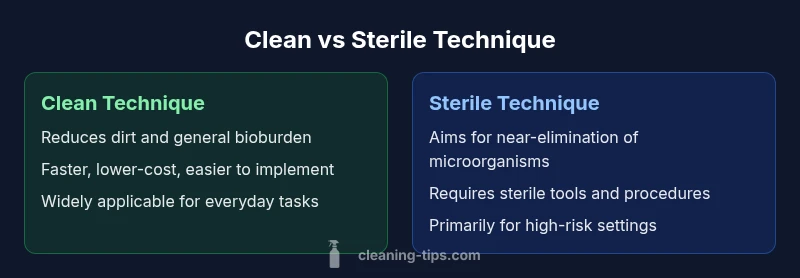
In everyday terms, clean technique focuses on removing dirt and reducing microbial presence using common cleaners, towels, and routine protocols that are practical for households. Sterile technique, by contrast, requires asepsis and sterile equipment to attempt to eliminate all microorganisms on a surface. The phrase <em>clean versus sterile technique</em> is often used to contrast ordinary sanitation with aseptic protocols. This distinction matters because most household tasks do not require sterile conditions, but they benefit from careful sanitation. According to Cleaning Tips, the goal of clean technique is to minimize risk through predictable routines, while sterile technique is reserved for tasks with higher risk or when contamination has severe consequences. The key is to align the method with the actual risk level of the task rather than blindly applying hospital-grade methods to every surface. In this guide, we explore how to apply both approaches appropriately, and what trade-offs each entails.
Historical context and modern relevance
The concepts of clean and sterile approaches originated in healthcare and laboratory settings but have since migrated into households and consumer products. Historically, sterile practices dominated clinical environments, where sterilization and aseptic handling minimize infection risk. In contemporary homes, clean technique has matured into reliable sanitation routines that balance effectiveness with practicality. The Cleaning Tips team notes that, while sterile practices are essential in medical contexts, most homes achieve safety through consistent cleaning, proper disinfection, and routine maintenance. This shift reflects a broader emphasis on risk-based cleaning: matching depth of sanitation to the actual likelihood and potential impact of contamination, rather than defaulting to hospital-grade methods for every surface.
Core differences: scope, controls, and outcomes
The core difference lies in scope: clean technique aims to reduce visible dirt and general bioburd n, while sterile technique seeks to eradicate all viable microorganisms on a surface. Controls for clean technique rely on validated cleaners, sufficient contact times, and routine PPE like gloves when appropriate; sterile technique adds sterile instruments, validated sterilization steps, and strict asepsis protocols. In terms of outcomes, clean technique reduces risk to a practical, acceptable level; sterile technique attempts near-zero microbial presence but with increasing complexity, cost, and training requirements. In home settings, the trade-off usually favors clean technique for daily tasks and reserves sterile methods for high-stakes tasks such as preparing food for vulnerable individuals or when caring for someone with significant health risks.
Real-world scenarios: kitchen, bathroom, laundry
Kitchen: Focus on surface cleaning, proper food-contact sanitation, and routine disinfecting of high-touch areas. Sterile technique is rarely necessary unless you are performing medical-grade prep or caring for someone with severe immune compromise.
Bathroom: Regular cleaning with appropriate cleaners is typically sufficient; consider targeted disinfection on toilets, sinks, and handles. Sterile procedures may be overkill for a standard family bathroom.
Laundry: Washing with appropriate detergents and water temperature reduces microbial load; sterile laundering is unnecessary for most textiles, though certain medical-grade fabrics or items from high-risk settings may warrant additional steps.
These contexts illustrate how clean technique covers most household tasks, while sterile practice sits at the edge of safety and precision for unique situations.
Tools, supplies, and best practices
For clean technique, stock basic cleaning agents (all-purpose cleaners, bathroom cleaners, glass cleaners), microfiber cloths, spray bottles, and clean gloves. For sterile technique, you would need sterilization devices (autoclaves) or single-use sterile tools, sterile gloves, and dedicated workspaces. Crucially, you should never mix sterile tools with non-sterile work unless you follow strict bridging protocols. Best practices include cleaning from least soiled to most soiled, allowing appropriate contact times, and keeping surfaces dry after disinfection to prevent recontamination.
Common myths and misapplications
- Myth: Sterile means 100% safe in every home task. Reality: Sterile methods reduce risk, but misapplication can create new hazards or false reassurance.
- Myth: More expensive products guarantee cleaner results. Reality: Proper technique and adherence to product labeling often trump price.
- Myth: You must use sterile tools for kitchens. Reality: Routine disinfection with proper cleaners is sufficient for most surfaces.
Understanding these misconceptions helps prevent overkill or under-cleaning and keeps tasks aligned with risk.
Step-by-step: applying clean technique safely
- Define the task and risk level. 2) Gather appropriate cleaners and PPE (gloves, eye protection as needed). 3) Clean visibly dirty surfaces with an approved cleaner; rinse if required. 4) Apply a disinfectant with the recommended contact time. 5) Allow surfaces to air-dry; avoid recontamination by covering or storing cleaned items. 6) Sanitize high-touch points regularly and review routines for new hazards.
This sequence emphasizes practical, repeatable routines that balance safety with efficiency.
Health implications and risk management
Regular cleaning reduces surface bioburden and can lower the chance of transmission of common pathogens. Sterile techniques provide higher assurances in controlled settings, but improper application or inadequate training can introduce risks, such as chemical exposure or cross-contamination. Household guidance prioritizes consistent cleaning and proper ventilation to support indoor air quality, aligning with public health recommendations.
Time, cost, and practicality considerations
The time investment for clean technique scales with frequency and surface area; costs stay within typical household budgets. Sterile technique can dramatically increase time requirements and material costs, often without proportional gains in a home environment. When budgeting for cleaning, weigh the risk profile of surfaces, the presence of vulnerable individuals, and your tolerance for complexity. The result is a pragmatic plan that emphasizes routine maintenance over hospital-grade workflows.
Industry guidance and applying in homes
Healthcare and laboratory standards emphasize asepsis, but home cleaning benefits from a risk-based approach. Public health guidance encourages consistent cleaning, correct use of disinfectants, and attention to ventilation. In practice, apply sterile methods only when risk assessment indicates a clear benefit and you have adequate training and equipment to do so safely. The general principle is to maximize safety with reasonable effort, not to emulate clinical sterile environments in ordinary rooms.
Authority sources and how to consult them
- Centers for Disease Control and Prevention (CDC): general guidelines on cleaning, sanitizing, and disinfecting for households.
- World Health Organization (WHO): recommendations on infection prevention and home hygiene.
- National Institute of Environmental Health Sciences (NIEHS): environmental health considerations for safe cleaning practices.
For specific tasks, consult product labels and local health authorities to ensure compliance with regulations and recommendations.
Decision framework: when to escalate to sterile
If you are cleaning surfaces that come into contact with open wounds, preparing sterile medical foods, or caring for someone with significant immunosuppression at home, evaluate sterile technique. For typical tasks—counters, floors, bathrooms—clean technique provides adequate protection when combined with proper disinfection and ventilation. Use sterile procedures only when risk assessment indicates a meaningful benefit and you have adequate training and equipment to do so safely.
Comparison
| Feature | Clean technique | Sterile technique |
|---|---|---|
| Definition | Focus on removing dirt and reducing general microbial presence with common cleaners | Aseptic approach aiming to eliminate all viable microorganisms on a surface |
| Typical contexts | Routine household tasks (kitchens, bathrooms, laundry) | High-risk settings and tasks (medical surfaces, sensitive prep work) |
| Required equipment | Common cleaners, cloths, gloves | Sterile instruments, sterile gloves, sterilization tools |
| Time and effort | Faster, simpler routines | More time-consuming, requires planning and training |
| Contaminant control | Reduces visible dirt and bioburden | Aims for near-zero microbial presence |
| Cost and access | Lower upfront cost; readily available products | Higher costs; specialized equipment may be needed |
| Best for | Everyday cleanliness and risk mitigation for households | Tasks with high biosafety requirements or vulnerable individuals |
Strengths
- Faster, practical routines for daily cleaning
- Lower equipment and product costs
- Easier for households to train multiple people
- Adequate protection for routine sanitization and disinfection
Weaknesses
- Does not achieve near-sterile conditions for high-risk tasks
- Can create a false sense of safety if misapplied
- Not suitable for healthcare-grade workflows or immunocompromised settings
Clean technique generally wins for home use; sterile technique is reserved for high-risk tasks.
For most households, routine cleaning and proper disinfection provide meaningful protection with less effort and cost. Reserve sterile methods for situations with elevated risk or specific guidance from health authorities; misusing sterile protocols at home can introduce new hazards. The Cleaning Tips team emphasizes a risk-based approach to cleaning.
Questions & Answers
Is sterile technique always necessary at home?
No. For typical household tasks, clean technique combined with proper disinfection is usually sufficient. Sterile methods are reserved for selected high-risk situations or healthcare-like tasks.
Not usually. Home cleaning mostly relies on routine cleaning and disinfection; sterile methods are for special cases.
Can I use regular cleaners for sterile tasks?
No. Sterile tasks require sterile equipment and procedures to minimize contamination. Regular cleaners alone do not guarantee sterility and should not replace aseptic protocols in high-risk settings.
Regular cleaners aren't enough for sterile tasks; you’d need sterile equipment and procedures.
Are PPE requirements different between clean and sterile techniques?
Yes. Clean technique may require basic PPE like gloves; sterile technique often requires more stringent PPE and strict handling rules to maintain asepsis.
Sterile work usually means more protective gear and stricter handling rules.
What are common misconceptions about clean technique?
Common myths include that sterile always equals safe in homes, or that expensive products automatically yield better cleanliness. Correct use and adherence to guidelines matter more.
Don't assume sterile is always safer at home; follow proper guidelines instead.
When should I escalate from clean to sterile methods?
Consider sterile methods if there’s open wounds exposure, immunocompromised individuals, or high-risk materials. Always consult health guidance before escalating.
Only escalate to sterile methods when risk assessment justifies it and you’re properly trained.
How do I assess risk for a cleaning task?
Evaluate surface type, contact with food or wounds, the health status of occupants, and the potential consequences of contamination to decide the appropriate method.
Think about who uses the space and what could go wrong if it isn’t perfectly clean.
The Essentials
- Prioritize routine cleaning and disinfection for everyday tasks
- Use sterile technique only for high-risk surfaces or vulnerable populations
- Follow product labels and validated disinfection contact times
- Balance time, cost, and risk when selecting methods
- Maintain good ventilation to support overall home hygiene