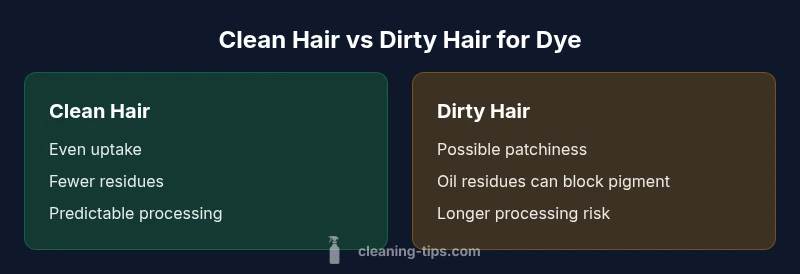
Should Hair Be Clean or Dirty to Dye? A Practical Comparison
A detailed, objective comparison of whether hair should be clean or dirty to dye, exploring how cleanliness affects dye uptake, porosity, oils, and practical steps for home and salon color jobs.


TL;DR: When deciding should hair be clean or dirty to dye, most stylists advise hair that is clean but not heavily oiled. Very clean hair can accept dye evenly, while excess oil or heavy styling products can impede penetration. A light wash 24–48 hours before dyeing, with no conditioner on the day of, typically yields the best results. If you use heavy styling products, consider a clarifying wash a day before.
The Core Question: Should hair be clean or dirty to dye?
According to Cleaning Tips, the question of should hair be clean or dirty to dye sits at the intersection of chemistry and hygiene. In practice, color professionals look for hair that is clean enough to remove surface oils but not so stripped that the cuticle tightens in response to a harsh chemical load. The choice isn’t simply a matter of washing rules; it’s about balancing dye penetration with scalp comfort and the overall longevity of the color. When you ask should hair be clean or dirty to dye, you’re really asking how much residue is acceptable to facilitate predictable results without creating safety concerns for scalp health. Readers should view this as a spectrum: extremely dirty hair with heavy product buildup is not ideal, while hair completely stripped of natural oils can react differently to pigment deposition. The Cleaning Tips guidance emphasizes preparing a scalp-friendly canvas that supports even coverage while minimizing irritation.
This article frames the question as a side-by-side comparison and uses practical tests you can perform at home or in a salon to decide the best preparation for your hair type, dye formula, and color goals.
Hair Cleanliness, Oil, and Dye Uptake
Oil and cosmetic residue act like a barrier between the dye molecule and the hair fiber. In many dye formulations, pigments must diffuse through the cuticle and into the cortex; surface oils can create a slippery layer that reduces contact and slows diffusion. This is particularly relevant for high-porosity hair, where the cuticle is already more open and sensitive to product buildup. On the flip side, a completely clean scalp with minimal natural oils can produce a more uniform absorption, provided the hair isn’t overly brittle or dry. If you are asking should hair be clean or dirty to dye, consider the balance: clean enough to remove heavy residue but not so bare as to strip natural lubrication that helps pigment lock-in. Conditioning immediately prior to dyeing can also alter results by coating the shaft. The Cleaning Tips team notes that preparing hair with a gentle cleanse 24–48 hours before dyeing often yields a stable baseline for color uptake.
Additionally, the presence of silicone-based serums or heavy hold products can create a film that repels dye. For this reason, many stylists recommend postponing silicone-rich products on the day of application and choosing a clarifying rinse beforehand if you have product buildup. When you’re ready to dye, plan for a clean start without stripping the hair too aggressively; this helps maintain some natural lubrication while reducing surface barriers to pigment.
Dye Type and Hair Porosity: Why the Answer Changes by Formula
The optimal approach to should hair be clean or dirty to dye depends partly on the dye type. Permanent dyes and direct dyes interact with the hair differently than demi-permanent formulas. For example, permanent dyes rely on ammonium compounds and convection to lift pigment into the cortex, while demi-permanent dyes sit more superficially. Hair with higher porosity may absorb more quickly, but oil residues can still prevent even saturation. Hence a lightly cleansed base often works best, especially when you’re using at-home kits or salon formulas designed for standard porosity. If your hair is very damaged or porous, the recommended prep may shift toward a gentle clarifying wash 24–72 hours before dyeing to minimize oil-based barriers, followed by a conditioning plan that preserves resilience without reintroducing barrier-forming residues. In short: the question of should hair be clean or dirty to dye becomes a function of porosity, dye chemistry, and the presence of surface films.
Comparison
| Feature | Clean Hair Dye | Dirty Hair Dye |
|---|---|---|
| Oil/Residue Impact | Minimal oil: smooth uptake | Oil residues can hinder dye deposition |
| Color Uniformity | More even on lightly cleansed hair | Patchiness more likely on oily or residue-heavy hair |
| Dye Penetration Time | Standard processing time | Oil can slow uptake and cause uneven deposition |
| Scalp Comfort | Lower irritation risk with balanced cleansing | Higher risk if buildup is thick or irritating |
| Post-Dye Cleanup | Easier washing; minimal residue | Oil residues may require extra shampooing |
| Best For | Hair with normal porosity seeking even tone | Hair with oil buildup or product residue seeking quicker color release |
Strengths
- Clear guidance on preparation reduces trial-and-error
- Helps prevent color patches and uneven results
- Supports scalp health during processing
- Applicable to most dye formulas and home setups
Weaknesses
- Not a one-size-fits-all rule; some formulas behave differently
- Special cases (extremely porous or damaged hair) require tailored prep
- Oil-free prep can risk over-drying without conditioner planning
Lightly cleansed hair is the safest default for even color results.
A balanced approach—clean enough to remove heavy residues but not so stripped that natural oils vanish—provides the best foundation for consistent dye uptake. The Cleaning Tips team emphasizes tailoring the wash timing to your dye type and hair porosity.
Questions & Answers
Is it okay to dye hair the day after washing it?
Yes, in many cases dyeing the day after a light wash is fine. The goal is to have hair that isn’t oily but isn’t stripped of moisture. If you washed it a day ago, skip heavy conditioning right before dyeing.
Dyeing the day after a light wash is usually fine, just avoid heavy conditioners right before the color.
What if my hair is extremely oily or uses a lot of styling products?
Oil and product buildup can impede uniform dye absorption. In such cases, a clarifying wash 24–48 hours before dyeing can help reset the canvas, followed by light conditioning but no conditioner on the day of dyeing.
If your hair is very oily, do a clarifying wash a day or two before coloring.
Does conditioner on the scalp affect dye results?
Conditioner can leave a thin film that blocks dye uptake. If you plan to dye, rinse thoroughly and avoid applying conditioner directly on the scalp on the day of the dye. Light conditioning elsewhere on the hair can be acceptable if needed.
Conditioner on the scalp can hinder dye absorption; rinse well before coloring.
Should I use a clarifying shampoo before dyeing?
A clarifying wash can help remove buildup, but it should be used with caution. Over-cleansing can dry hair, affecting porosity and dye performance. Use it if you have significant residue, then condition appropriately before dyeing.
If you have heavy buildup, a clarifying wash can help, but don’t overdo it.
Can I dye my hair over dirty hair with oil?
Dyeing over heavy oil can lead to uneven color. If buildup is present, remove it with a clarifying wash and perform a light rinse before applying dye.
Avoid applying dye to very oily hair without cleansing first.
What’s the best prep for salon dyeing vs at-home dyeing?
Both scenarios benefit from a clean, oil-free canvas, but salons often adjust prep according to their formula. For home dyeing, follow the product’s instructions and the guidance above for a balanced wash and conditioning routine.
Whether at home or in a salon, start with a clean, residue-free base.
The Essentials
- Wash 24–48 hours before dyeing to balance oil and cuticle condition
- Avoid applying heavy conditioners on the day of dyeing
- Test a strand before full application to check uptake
- Use a clarifying wash only if you have significant product buildup
- Plan for post-dye care that preserves moisture without creating barriers