Is Clean or Dirty Hair Better to Dye? An Analytical Comparison
Explore whether clean or dirty hair yields better dye results. This analytical guide covers dye chemistry, scalp health, prep tips, and real-world scenarios for lasting color.


Is clean or dirty hair better to dye? The short answer is usually clean hair, as a residue-free surface allows for even pigment uptake and predictable color. However, some formulas respond differently to light oils, so always follow the product's instructions and perform a patch test. For many traditional dyes, starting with clean hair yields the most reliable results, while specialized formulas may require adjustments.
Understanding the Question: is clean or dirty hair better to dye
According to Cleaning Tips, is clean or dirty hair better to dye? The short answer is that clean hair typically yields more even color because a residue-free surface lets pigments deposit uniformly across each strand. Yet the landscape is nuanced. Some color systems and conditioning formulas incorporate oils or silicones that can alter uptake, and certain hair states—such as a light layer of natural oils or recent conditioning—may offer specific advantages for shine or gloss. This section builds a practical framework for deciding how to prepare hair for dyeing, so you can align your approach with the dye chemistry and your goals. The aim is not to label cleanliness as inherently good or bad, but to match your hair state to the product you are using. The Cleaning Tips team emphasizes that most traditional dyes perform best on clean hair, with caveats for specialty formulas and glossy finishes.
keyIdeaLinksDescribeEverything
true
words: placeholder
Comparison
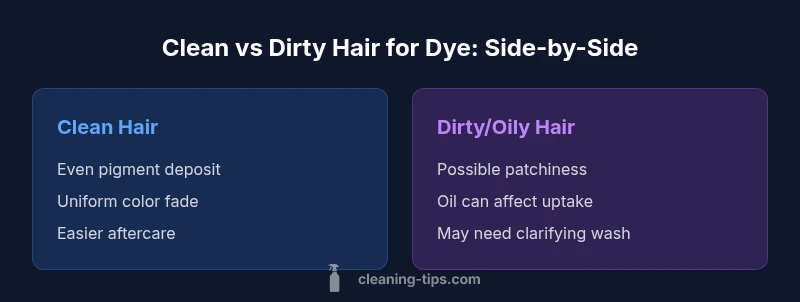
| Feature | Clean hair (recently washed) | Dirty/oily hair (not washed) |
|---|---|---|
| Color outcome | More even deposition and predictable tone across strands | Potential patchiness or uneven uptake if oils or residues interfere with dye |
| Pigment penetration | Direct access to the cortex with minimal barriers | Oil or residue can create a temporary barrier to penetration |
| Texture and feel after dye | Typically cleaner feel and more uniform texture after washing | Oil residues may require thorough washing to remove sheen or heaviness |
| Scalp comfort | Less risk of scalp irritation when skin is not coated with heavy products | Oils near the scalp can react with certain dyes, potentially causing irritation for sensitive individuals |
| Best use case | Traditional permanent and most semi-permanent dyes | Some gloss or conditioning formulas may perform differently with oil coatings |
Strengths
- More predictable color results with clean hair
- Easier diagnosis and fixing of color issues
- Cleaner processing and cleanup
- Better baseline for full-coverage shades
Weaknesses
- Oil residues can affect pigment uptake in some formulas
- Overwashing can strip natural oils, leading to dryness or brittle hair
- Some formulas are designed to work with footage of natural oils or silicones and may require adjustments
Clean hair is typically the better baseline for dyeing; dirty hair can be workable in specific, formula-driven scenarios.
For most traditional dyes, starting with clean hair yields even color and easier maintenance. Dirty hair may be acceptable in select cases with particular formulas or gloss goals, but always follow product guidance and perform a patch test before a full application.
Questions & Answers
Should I wash my hair before dyeing?
In most cases, washing hair before dyeing helps remove product buildup and creates a clean canvas for pigment. However, always check the dye instructions and perform a strand test to confirm; some formulas may tolerate light conditioning or require specific preparation.
Most dyes perform best on clean hair, but always patch-test and follow the product guide.
Can I dye on oily hair?
Dyeing on oily hair can be done for certain formulas, but results may vary. Oils can slightly alter pigment deposition, potentially leading to uneven tone. If you choose this route, patch-test and be prepared to adjust technique or wash after application.
Oil can affect pigment, so test first and follow the product's guidance.
How long should I wait after washing before dyeing?
Follow the dye package instructions. If uncertain, ensure the hair is dry and free of heavy conditioner residues, and consider a strand test to check how your hair state behaves with the dye.
Consult the product guide and do a strand test before committing.
Does semi-permanent dye perform differently on clean vs. dirty hair?
Semi-permanent dyes deposit more gradually and can be influenced by surface conditions. Clean hair generally provides more even results, while a light oil layer might alter deposit patterns in some formulas. Patch testing is essential.
Patch test and follow the formula’s instructions.
What myths exist about oils and dye uptake?
A common myth is that oil always improves dye uptake. In reality, oils can either help gloss or hinder even deposit depending on the dye chemistry. Testing and adhering to instructions is the safest approach.
Oil effects vary by product; test first.
How should I handle touch-ups if I dyed on dirty hair?
If a touch-up is needed, assess the color match and oil state. You may rewash and reapply, or perform a targeted refresh on the strands that show unevenness, guided by the dye’s instructions.
Compare color on a strand and adjust accordingly.
The Essentials
- Prioritize clean hair for even color results
- Always patch-test and follow product instructions
- Patch-test for any oil-based conditioner or residue
- Use a strand test to confirm even uptake before full application
- Consult a professional for tricky color jobs