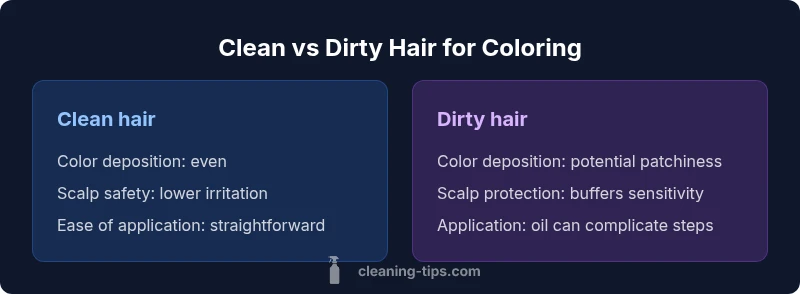
Clean vs Dirty Hair for Coloring: A Practical Guide
Compare clean and dirty hair for coloring across dye types, deposition, and scalp safety. An analytical guide from Cleaning Tips with practical steps, myth-busting, and maintenance tips for homeowners and renters.


Short answer: clean hair generally yields more even color deposition, while a light layer of natural oil can help protect the scalp for oil-based dyes. However, dye formulations vary, and some direct dyes or conditioning formulations perform best on slightly oily hair. Always follow the product instructions and run a strand test to confirm how your hair responds before committing to full coverage.
How cleanliness affects color deposition and dye performance
Hair color performance is a function of surface oils, cuticle condition, and porosity. Clean hair typically provides a predictable canvas where pigments can penetrate evenly, producing uniform tone across lengths. However, a light layer of natural oil on the scalp can serve as a buffer for sensitive skin and may influence how some formulas cling to strands. When asking is clean or dirty hair better for coloring, remember that dye chemistry matters: permanent dyes, semi permanent options, and direct dyes interact with the hair surface differently. People with high porosity may see faster uptake on clean hair, while low porosity hair can sometimes benefit from a tiny amount of surface oil to balance deposition. In practice, the safest approach is to start with hair that is clean but not heavily stripped of natural oils, then adjust if the dye provider recommends otherwise and experiment with a strand test. The bottom line: there is no one-size-fits-all answer; tailor your method to the dye you use and your hair’s unique condition. Cleaning Tips analysis supports this nuanced view and emphasizes testing before committing to a full color.
How cleanliness affects color deposition and dye performance
Hair color performance is a function of surface oils, cuticle condition, and porosity. Clean hair typically provides a predictable canvas where pigments can penetrate evenly, producing uniform tone across lengths. However, a light layer of natural oil on the scalp can serve as a buffer for sensitive skin and may influence how some formulas cling to strands. When asking is clean or dirty hair better for coloring, remember that dye chemistry matters: permanent dyes, semi permanent options, and direct dyes interact with the hair surface differently. People with high porosity may see faster uptake on clean hair, while low porosity hair can sometimes benefit from a tiny amount of surface oil to balance deposition. In practice, the safest approach is to start with hair that is clean but not heavily stripped of natural oils, then adjust if the dye provider recommends otherwise and experiment with a strand test. The bottom line: there is no one-size-fits-all answer; tailor your method to the dye you use and your hair’s unique condition. Cleaning Tips analysis supports this nuanced view and emphasizes testing before committing to a full color.
Comparison
| Feature | Clean hair | Dirty hair |
|---|---|---|
| Color deposition | More even on clean hair | Oil layer can cause patchiness or uneven uptake |
| Porosity interaction | Porosity differences clearer on clean surfaces | Oil residue can mask porosity effects in some formulas |
| Scalp safety | Lower irritation with a clean base | Oil offers protective buffer but may trap pigment near scalp |
| Application ease | Cleaner canvas for precise application | Oils can complicate even pigment distribution |
| Best for | Base color and even tone for most formulas | Scalp protection with certain oil-based or conditioning dyes |
| Fade and maintenance | Predictable fade with clean base | Oil presence can alter perceived fade and need tailored care |
Strengths
- Facilitates consistent color deposition for most formulas
- Reduces risk of patchy results on the mid-length and ends
- Simplifies timing and processing in home coloring
- Supports predictable fade when following product guidelines
Weaknesses
- Requires more prep if you want an oil-free base
- Oil on the scalp can interfere with some dye chemistries
- Not all formulas tolerate surface oils equally
Clean hair generally provides the most reliable color results.
For most dye formulations, starting with clean hair yields even deposition and predictable outcomes. If your color routine includes oils or conditioning treatments, follow the dye instructions and perform a strand test to tailor the approach.
Questions & Answers
Should I wash my hair before coloring?
In most cases, starting with clean hair provides a more even color deposition. A mild wash to remove buildup without stripping natural oils is often recommended. Always review your dye instructions and perform a strand test.
Usually wash before color for the best results, but keep a light layer of natural oils if you have sensitive skin.
Can I color oily hair or after an oil treatment?
Oils can act as a barrier to pigment deposition with some formulas. If you must color oily hair, opt for dyes designed to work with oils and perform a strand test. For many dyes, washing away excess oil before application yields more consistent results.
Oils can affect color deposit, so follow dye instructions and test first.
Does porosity determine whether clean or dirty hair is better for coloring?
Porosity influences how color penetrates. Clean hair can reveal porosity differences more clearly, while surface oils may blur those differences for certain formulas. A strand test helps you see how your hair will respond.
Porosity matters; test a strand to see how your hair takes color.
What if the color looks uneven after coloring?
Uneven results often relate to buildup, oil residue, or porosity variation. Review the dye’s instructions, re-wash the scalp if needed, and consider a strand test on different sections to decide whether a reapplication on clean hair is appropriate.
If color is uneven, re-test a strand and adjust prep next time.
Is a strand test essential before full application?
Yes. A strand test helps you predict how the dye will behave on your hair state, especially regarding oils and porosity. It reduces risk and guides timing and aftercare decisions.
Strand tests are highly recommended before full application.
The Essentials
- Prioritize a clean canvas for most color formulas
- Do a strand test to tailor the approach
- Follow dye instructions for best results
- Consider hair porosity and scalp sensitivity when deciding on cleanliness