Clean or Dirty Hair for Coloring: A Practical Comparison
A rigorous comparison of clean vs. dirty hair for coloring, examining porosity, oil effects, dye types, and practical prep. Learn how hair state impacts pigment uptake and longevity for reliable at-home or salon color results.


Quick Answer: In most home color jobs, clean hair provides the most even uptake and predictability of results. If your hair is very oily or highly porous, a light clarifying wash followed by a small amount of natural oil can help prevent over-drying and uneven lift. The deciding factor is hair porosity and the dye type you’re using.
Understanding the premise: clean or dirty hair for coloring
The core question—clean or dirty hair for coloring—shapes your prep plan. Hair surface, porosity, and sebum create microenvironments that determine pigment uptake. According to Cleaning Tips, the hair's oil burden can act like a barrier or a lubricant, depending on the dye type. Home colorists often ask whether washing before color is necessary. The short answer is: there's no one-size-fits-all rule; your decision should reflect porosity, strand health, and the product's formulation. In practice, many homeowners start with a clean scalp and hair to minimize impurities, then rely on a gentle oil residue to support conditioning. The goal is reliable pigment penetration without excessive swelling or damage. We'll explore how to assess your hair, what to expect from different states, and how to tailor prep steps for salon-grade results at home.
How sebum and hair porosity influence color absorption
Hair sebum and porosity determine how deeply pigments penetrate the cortex. A waxy film on the cuticle can slow dye molecules, while high porosity creates gaps that may cause faster uptake but uneven saturation. Clean, clarified hair often provides a predictable baseline, especially with standard permanent dyes. In contrast, slightly oily hair can act as a natural buffer that reduces scalp irritation and may limit lift in high-porosity strands. In practice, the choice depends on your hair's history (chemical processing, heat damage) and the dye's developer strength. Cleaning Tips recommends a quick porosity check: when you run a strand between your fingers, does it feel dry and rough or smooth and flexible? The answer guides whether to wash more or less before coloring.
When clean hair is preferable: ideal conditions for dye results
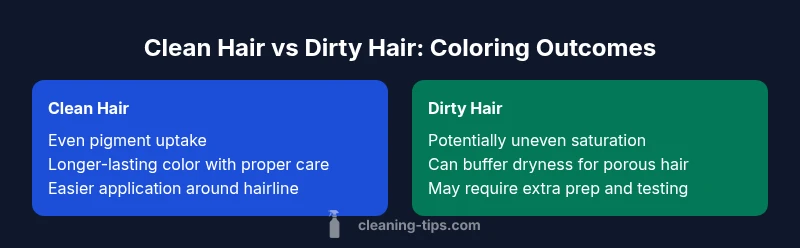
Clean hair is generally favored when color saturation must be even from roots to ends and when scalp health is a priority. For most at-home color formulas, starting with a clean slate minimizes impurities that could block pigment. Clean hair also makes it easier to apply dye precisely around the hairline and partings, reducing patchiness. If your hair is chemically treated, bleached, or previously colored, a clean base helps you assess how much lift the dye needs without interference from oils. The goal is uniform porosity, short of over-drying, so you can monitor the exact color outcome and adjust processing times accordingly.
When slightly dirty hair may be advantageous: mid-level oils and dye lift
In some scenarios, leaving a thin oil layer or slight natural oils can benefit color uptake on very porous hair or when using semi-permanent formulas that rely on surface deposition. Oils can lubricate and protect the scalp during processing, while a small amount of oil near the mid-lengths may help prevent excessive dryness. However, this approach requires careful control: too much oil reduces pigment penetration and can lead to uneven results. If you choose this route, use a light clarifying wash to remove heavy buildup and test a small strand to observe how the dye takes.
Impact on dye longevity and fade resistance
Hair state at coloring affects how pigment bonds hold over time. Clean hair often yields sharper, longer-lasting results because the cuticle layer is evenly accessible to dye molecules. Oily or dirty hair can sometimes promote uneven penetration, which may fade more quickly in oily zones or in areas with buildup. On the other hand, a tiny amount of oil might help preserve fiber integrity during processing, especially for damaged hair, reducing breakage that could otherwise contribute to color loss. The key is balance: avoid excess oil that blocks pigment, but preserve enough natural lipids to maintain strand health.
Practical prepping steps for different hair states
For clean hair: wash with a mild, sulfate-free shampoo and avoid heavy conditioners on the day of coloring. For slightly dirty hair: skip heavy styling products and perform a light clarifying rinse to reduce buildup, then towel-dry before applying dye. For very oily hair: consider a brief clarifying wash, then air-dry to a light, just-damp state. Always follow the dye manufacturer's instructions for timing and patch testing. If you’re unsure, perform a strand test to gauge uptake and adjust your plan accordingly. Cleaning Tips emphasizes consistency: plan ahead, and document your results to refine your approach over time.
Common myths debunked
Myth: Dirty hair always helps lift color. Reality: Oils can interfere with pigment deposition, especially with high-lift formulations. Myth: Clean hair always yields the longest-lasting color. Reality: Longevity depends on porosity, formula, and post-color care; clean hair alone does not guarantee fade resistance. Myth: You must clarify wash every time. Reality: Over-washing can strip moisture and damage hair, so tailor washing to your hair's condition and the dye's requirements.
Choosing the right dye formulation for your hair state
Dye formulation matters as much as hair state. Permanent dyes rely on oxidative developers to open the cuticle and deposit pigment, which can be hindered by oils near the shaft. Demi-permanent and semi-permanent options sit closer to the surface, making the presence of oils more influential on result and longevity. If your hair is very dry or porous, you may prefer lower-volume developers or conditioning formulas that reduce damage while still delivering color. Always patch test and follow the included instructions to minimize risk and ensure predictable outcomes.
Case scenarios: examples to illustrate decisions
Scenario A: Normal, unprocessed hair with a mid-length porosity. Start with clean hair, perform a strand test, and apply a standard permanent dye. Scenario B: Hair with recent chemical lightening and high porosity. A gentle clarifying wash beforehand, followed by a conditioning treatment, can help monitor lift and reduce over-drying. Scenario C: Frizzy, low-porosity hair that holds oils well. A light wash, avoiding heavy conditioners, helps ensure even pigment uptake and reduces patchiness. These real-world examples show how the state of the hair shapes prep steps and outcomes.
Post-dye care to maximize results
Post-color care continues the logic of porosity and cleanliness. Use color-safe shampoos with pH-balanced formulas, and limit overwashing in the first days after coloring. Consider a lightweight conditioner or leave-in treatment to support moisture without creating a barrier that blocks pigment. Protect hair from heat styling and UV exposure, which can accelerate fading. Regular scalp care and moisture management help stabilize results over time, especially for porous or chemically treated hair.
Quick-start checklist for your next color appointment
- Identify hair porosity and note any recent chemical work.
- Decide on wash state (clean or light clarifying with minimal oil left).
- Patch test the dye on a small strand and observe uptake.
- Choose a dye formulation aligned with your porosity and desired longevity.
- Prepare scalp and hair with appropriate products and tools.
- Set realistic processing times and monitor closely for even saturation.
- Plan post-color care to protect results and minimize damage.
- Document outcomes for future color decisions and adjustments.
Expert tips from Cleaning Tips on color safety and color correction
Color decisions should prioritize safety and hair health. If results don’t match expectations, avoid aggressive color corrections in one sitting. Instead, assess porosity, wait time, and formulation, and consider expert guidance before attempting corrections. The Cleaning Tips team recommends gradual adjustments and routine conditioning to keep hair resilient between color sessions.
Comparison
| Feature | clean hair | dirty hair |
|---|---|---|
| Color absorption speed | consistent, predictable uptake | potentially slower or uneven due to oils |
| Evenness of color | more uniform saturation across strands | risk of patchiness with buildup |
| Color longevity | generally longer-lasting with proper care | may fade quicker if oils hinder penetration |
| Pre-treatment needs | often none beyond patch test | may require clarifying wash or pre-treatments |
| Best for | standard permanent dyes on normal porosity hair | high-porosity or oily hair needing careful lift control |
Strengths
- Clear baseline results with clean hair for most formulas
- Better dye pigment uptake on clean, impurity-free hair
- Easier to achieve even saturation across the head
Weaknesses
- Over-cleansing can strip moisture and damage hair
- Oily or dirty hair may hinder pigment penetration in some formulas
- Excess oil requires clarifying steps that risk strand dryness
Clean hair is the safer default for uniform color; oily or highly porous hair may benefit from a light clarifying wash and minimal oil residue.
Overall, start from a clean base for most home color jobs. If you know your hair is very porous or prone to oil buildup, adjust with a mild clarifying step and test a strand first. The best approach depends on porosity and the dye formula you use.
Questions & Answers
Should I wash my hair before coloring, or can I color with dirty hair?
It depends on porosity and dye type. In most cases, washing with a mild shampoo creates a clean canvas for even pigment uptake. For very oily or highly porous hair, a light clarifying wash followed by a small amount of natural oil can help manage lift and conditioning. Always patch test first.
Most people should wash lightly before coloring to ensure even results. Patch test first to tailor the prep to your hair's porosity.
How does hair porosity affect the decision to wash before coloring?
Porosity controls how much pigment can penetrate the cortex. Low porosity hair benefits from clean, oil-free strands for even saturation, while high porosity hair may need a light oil barrier post-clarifying to prevent excessive dryness and uneven lift. Patch tests help confirm your plan.
Porosity guides prep: low porosity loves a clean canvas; high porosity may tolerate a touch of oil after clarifying.
Can I color over hair that was just colored or chemically treated?
Yes, you can, but prep matters more. Check porosity, assess lift, and consider a clarifying wash if buildup exists. Follow the product’s guidelines and do a strand test to gauge how the new color will take on treated hair.
Coloring over treated hair works with careful prep and a strand test.
What’s the role of clarifying shampoo in pre-color prep?
A clarifying wash helps remove residue that can block pigment, especially if you use styling products. Do not overdo it; you want clean but not stripped hair. If your hair is naturally clean, you may skip clarifying and proceed with a light wash instead.
Clarifying helps ensure pigment can reach the cortex, but don’t overdo it.
Is it ever beneficial to apply oil before coloring?
A tiny amount of oil can buffer the scalp and reduce dryness on very porous hair, but too much oil blocks pigment. If you choose this route, apply a negligible amount away from the root area and patch test to observe uptake.
A little oil can help, but test first and avoid heavy application.
Which dye formulas work best with clean vs. dirty hair?
Permanent dyes generally perform best on clean hair for uniform saturation. Demi- and semi-permanent formulas may tolerate slight oil residues better but still benefit from a clean baseline. Always follow the product’s instructions and perform a strand test.
Most formulas do better on clean hair, but patch tests guide each choice.
The Essentials
- Assess hair porosity before choosing wash state
- Clean hair favors even saturation and predictability
- Slight oils can help if porosity is high, but test first
- Patch tests are essential regardless of hair state
- Post-color care extends color longevity