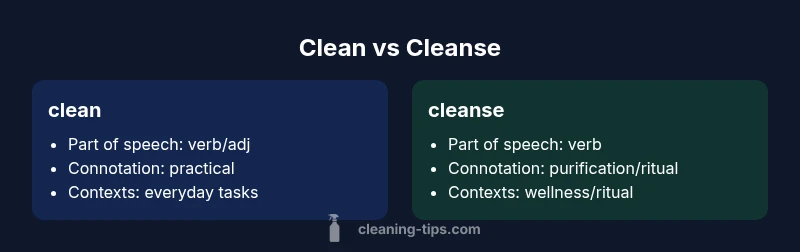
Clean vs Cleanse: A Practical, Analytical Guide
An analytical, side-by-side guide exploring when to use clean vs cleanse, with nuanced usage, regional notes, and practical examples for precise language.


TL;DR: clean and cleanse are related but not interchangeable. 'Clean' is practical, everyday language for removing dirt or maintaining hygiene, while 'cleanse' signals deeper purification or ritual-like transformation. In most writing, choose 'clean' for clarity and accessibility; reserve 'cleanse' for contexts that require emphasis on thorough purification or ceremonial nuance. Consistency matters for credibility.
Core distinction: clean vs cleanse
Understanding the differences between the verbs clean and cleanse is essential for writers, marketers, and health professionals who want precise language without ambiguity. In everyday language, the word clean denotes practical maintenance—removing dirt, germs, or clutter. It covers routines such as cleaning a kitchen, cleaning a window, or cleaning up a spill.
In contrast, cleanse carries a sense of deeper purification or transformation beyond surface-level removal. It is often used in wellness, detox, or ritual contexts to imply cleansing of the body, mind, or environment. While both words share a common root, their semantic fields diverge enough to influence tone, audience trust, and perceived thoroughness. When you confront the choice “clean vs cleanse,” the decision hinges on nuance, context, and your intended effect on the reader. According to Cleaning Tips, consistent word choice builds credibility with audiences seeking precise language. The bottom line: use clean for routine maintenance and mundane tasks, and reserve cleanse for contexts that imply deeper purification or ceremonial overtones.
Etymology and semantic evolution
The words clean and cleanse share a common ancestry in the Proto-Indo-European root meaning to purify or clear. Over time, clean evolved into a flexible, everyday verb and adjective with a broad range of practical applications—from cleaning a room to cleaning up a record. Cleansed concepts, however, emerged in more specialized registers, often tied to holistic wellness, detox programs, or ritual purification. This split in usage has reinforced two distinct semantic fields: the ordinary, workaday sense of removing dirt (clean) and the heightened, sometimes ceremonial sense of purification (cleanse). Writers should note that the latter is less about mechanical removal and more about transformation. Cleaning Tips highlights how understanding this history helps avoid missteps when drafting product descriptions, health claims, or instructional content. When you need to signal thoroughness or ceremony, cleanse fits; for day-to-day cleanup, clean is typically the better choice.
The everyday utility of 'clean' in daily tasks
Clean is the default choice for most daily tasks because it communicates direct action with minimal cognitive load. If a homeowner is wiping down a counter, washing dishes, or sanitizing a bathroom, clean conveys the action clearly and efficiently. In business and technical writing, clean remains the most reliable term because it avoids unnecessary embellishment and keeps instruction accessible. Moreover, collocations like clean up, clean out, clean surface, and clean room are familiar to readers across demographics, reducing the friction that often accompanies unfamiliar terms.
When used as an adjective, clean modifies nouns to imply a state of hygiene or order, as in a clean kitchen or a clean bill of health. This versatility makes clean particularly effective in headlines, checklists, and user manuals where speed and clarity matter. Cleaning Tips consistently finds that audiences respond better to concise, action-oriented language, especially in how-to guides and maintenance schedules. In short, for routine tasks and straightforward instructions, clean is the superior choice for readability and comprehension.
The specialized sense of 'cleanse' in wellness and ritual contexts
Cleansing carries stronger connotations of purification beyond surface-level dirt. In wellness circles, a cleanse may refer to a detox program or a regimen that claims to purify the body or spirit. In spa and skincare marketing, cleanse often appears in phrases such as cleanse and detox or cleansing ritual, where the emphasis is on renewal rather than mere dirt removal. This specialized sense makes cleanse useful in branding that aims to evoke holistic health, ritual atmosphere, or transformative outcomes. However, cleanse can feel opaque or exaggerated in ordinary contexts, which is a risk for general-audience communications.
In your own writing, use cleanse when you want to signal a deeper process, spiritual cleansing, or a perceived cleansing of toxins. Be mindful of audience expectations; readers may interpret cleanse as a stronger claim than intended. If a product or service is marketed as a simple cleaning solution, the word cleanse might appear out of place or even undermine credibility. When in doubt, test both options with readers or stakeholders to measure tonal impact. Cleaning Tips suggests pairing cleanse with precise qualifiers to avoid overpromising outcomes.
Tone, formality, and audience impact
Word choice sets the tone before the reader processes the content. Clean tends to read as practical, approachable, and universal, which makes it well-suited for consumer-facing manuals, how-to articles, and maintenance checklists. It also works well in professional settings where brevity matters. Cleanse, by contrast, elevates the register and can border on the ceremonial or health-forward. This makes cleanse a natural fit for wellness blogs, spa services, detox programs, or branding that seeks to convey luxury or thoroughness.
Branding decisions should weight frequency and consistency. If your content strategy emphasizes straightforward, actionable guidance, lean on clean and its well-worn collocations. If your campaign highlights renewal, purification, or ritual experience, cleanse can differentiate your tone, provided it is clearly defined and consistently applied. The Cleaning Tips approach is to align word choice with audience expectations; ensure that every instance of cleanse is justified by the surrounding content and claims. In all cases, avoid shifting tones mid-article unless a deliberate stylistic plan is in place.
Grammar, syntax, and common mistakes
This section covers common pitfalls and how to avoid them when choosing between clean and cleanse. First, avoid generic replacements like "we will cleanse the area" when a simple "clean the area" communicates the task more clearly. Second, beware of overusing cleanse in contexts that imply routine maintenance rather than transformation; this can confuse readers about the actual service or task. Third, remember that clean has multiple grammatical roles: as a verb (to clean), as an adjective (a clean surface), and as a noun in some idiomatic expressions (e.g., “keep it clean”). Mistakes often arise when writers treat cleanse as a direct synonym for clean, neglecting its specialized connotations. Finally, be mindful of regional preferences: some audiences expect more direct terms, while others may respond to the softer, ceremonial tone associated with cleanse. By maintaining a clear rule set for each word, you can preserve precision and readability across genres.
Brand and marketing considerations: consistency matters
In marketing materials, consistency is essential for audience trust. If you start a campaign using clean to describe routine maintenance or product efficacy, continue that usage across all channels to avoid cognitive dissonance. Conversely, if your brand voice aims to evoke renewal, purification, or spa-like luxury, cleanse can be a powerful differentiator when used sparingly and with clear qualifiers. The risk of overusing cleanse is creating an impression of exaggeration or excessive health claims, especially in product descriptions. Cleaning Tips recommends drafting a style guide that codifies which contexts warrant each term, with explicit examples. This ensures that the tone remains cohesive from social posts to packaging copy. Additionally, when targeting global audiences, note that regional dialects can influence how readers interpret cleanse; pretesting messages with diverse groups can reveal potential misalignments before launch.
Regional variations: American vs British English and professional jargon
Regional differences can shape the acceptability and frequency of clean and cleanse. In American English, clean is ubiquitous in everyday speech and instruction; cleanse appears more often in wellness, beauty, and lifestyle contexts. In British English, cleanse may be encountered in health and ritual contexts, while clean remains the default term for practical maintenance. In professional or academic writing, cleanse can sound more formal or specialized, which may be advantageous in certain fields but risky in general consumer communication. Industry jargon also matters: cleaning products, service descriptions, and health claims may align more naturally with one word over the other. When developing content for international audiences, consider providing glosses or examples that clarify the intended meaning, and avoid assuming universal familiarity with the more niche sense of cleanse. Maintaining consistency across regional variants is essential to preserve credibility.
Practical examples: rewrites and edge cases
Here are paired examples to illustrate how the two words perform in real sentences. See how substitutions alter tone and implied depth:
- Everyday maintenance: “We will clean the kitchen this weekend.” vs. “We will cleanse the kitchen this weekend” (the latter sounds ceremonial and excessive for most households).
- Product copy: “This cleaner cleans surfaces quickly.” vs. “This serum cleanses the skin deeply.” (The first is practical; the second implies a more intense regimen.)
- Health context: “Clean your hands before preparing food.” vs. “Cleansing rituals can promote mindfulness.” (The first is routine; the second is ceremonial or wellness-focused.)
- Reporting: “The data clean the dataset of outliers.” vs. “The data cleanse operation removed noisy entries.” (The second reads as a technical procedure.)
- Brand voice: if your brand emphasizes straightforward results, avoid overusing cleanse; if your message centers on renewal, integrate cleanse with explicit benefits.
These rewrites demonstrate how small lexical shifts influence perception and trust. When editing, test each sentence in isolation and in context to ensure the chosen word aligns with the intended audience and objective.
Decision framework: a quick checklist
- Is the goal practical maintenance or transformation? If maintenance, use clean.
- Is there a sense of ritual or detox? If yes, consider cleanse with careful qualifiers.
- Is the audience general or specialized (medical, wellness, spa)? General audiences benefit from clean; specialized audiences may welcome cleanse.
- Does the claim require evidence or safety notes? Clean tends to be safer and clearer for everyday instructions; cleanse requires context to avoid sensationalism.
- Are you aiming for brevity or a luxurious tone? Clean supports brevity; cleanse can support a more elevated mood when defined clearly.
- Is there potential for confusion with similar terms (e.g., detox, purify)? Provide explicit context to prevent misinterpretation.
- Have you established a consistent usage rule in your style guide? Train editors to apply it uniformly across channels.
- Have you tested with real readers? Gather feedback to confirm tone and comprehension.
Wrapping up: the relationship between clarity and rhetoric
Clear language supports trust and action. The word clean is often the safest default because it communicates directly and with broad appeal. When you need to evoke deeper purification, or when your content aims to create a spa-like, ceremonial feel, cleanse can be valuable—provided you frame it with sufficient context so readers understand the implication. The most effective writing uses a deliberate word choice aligned with audience expectations and the intended outcome. By analyzing the nuances of clean vs cleanse and applying a consistent framework, writers can improve readability, reduce ambiguity, and strengthen brand voice. In the end, clarity should trump flamboyance; rhetorical flair adds color only where it serves the message.
Comparison
| Feature | clean | cleanse | ||
|---|---|---|---|---|
| Part of speech | verb/adj (as adjective) | verb | ||
| Connotation | practical, neutral | deep purification/ritual | ||
| Typical contexts | routine cleaning, maintenance, everyday tasks | wellness, detox, ceremonial cleansing | ||
| Formality | informal to neutral | formal/holistic | ||
| Common collocations | clean up, clean out, clean surface | detox cleanse, cleansing ritual, cleansing cream | ||
| Best for | everyday tasks and instruction | contexts signaling thorough purification or ritual emphasis | ||
| Examples | We will clean the kitchen. | This product cleans surfaces efficiently. | This section is clean and well-organized. | Pilgrims performed a cleansing ritual. |
Strengths
- Clear everyday utility that nearly everyone understands
- Low risk of misinterpretation in routine instructions
- Supports concise, scannable writing
- Widely supported by style guides and editors
Weaknesses
- Can sound bland in promotional copy
- Less effective for signaling depth or ceremony in health contexts
- Overuse may lead to repetitive phrasing
- Risk of ambiguity if paired with vague modifiers
Clean is the default winner for general use; cleanse has a niche for wellness, ritual, or precision-focused branding
For everyday writing and maintenance tasks, clean provides clarity and accessibility. Use cleanse when you want to imply deeper purification or a ceremonial vibe, but define the term clearly to keep reader expectations aligned.
Questions & Answers
Is 'cleanse' ever appropriate in everyday household contexts?
In most households, cleanse sounds unusual for routine chores and can confuse readers. It is better reserved for contexts that imply purification or detox-like connotations. When used, pair it with explicit qualifiers to avoid misinterpretation.
Usually not for the everyday tasks; use when you want to imply purification.
Can 'clean' be used as a noun?
In standard usage, clean acts as a verb or adjective. It can be part of noun phrases like 'the clean' in some contexts, but this is less common and often sounds awkward. Prefer pronoun-friendly noun substitutes like 'cleanness' or rephrase.
As a verb/adjective mainly; noun usage is rare.
What are common collocations for 'clean' and 'cleanse'?
Common collocations for clean include up, out, and surface. For cleanse, look for phrases like cleansing ritual, cleansing cream, or detox cleanse. Collocations help signal the intended nuance to readers.
Watch the phrases around each word to keep tone right.
Does British English treat these words differently than American English?
Both varieties favor clean for practical tasks. cleanse appears in wellness or ritual contexts in both regions, but frequency and nuance may vary by industry. When writing for a global audience, define the intended nuance to avoid regional misinterpretation.
Generally similar, with regional nuance in contexts.
How do I decide which word to use in branding?
Define your brand voice: use clean for clarity and breadth; use cleanse if you want to evoke renewal or luxury and you can justify the deeper process it implies. Maintain consistency across campaigns and platforms to avoid mixed messages.
Set a rule in your style guide and stick to it.
Is there a difference in meaning between 'to clean out' and 'to cleanse out'?
Indeed. 'Clean out' is a phrasal verb signaling removal of contents or clutter. 'Cleansing out' is far less common and sounds unnatural in most contexts, and should be avoided unless you’re describing a ritual or wellness framework where the term has predefined meaning.
Prefer 'clean out' for routine removal; 'cleansing out' is rare.
The Essentials
- Prioritize clean for everyday tasks and instructions
- Reserve cleanse for wellness/ritual contexts with clear qualifiers
- Maintain a consistent usage rule across channels
- Test tone and clarity with target readers before publishing
- Balance brevity with precision to maximize trust