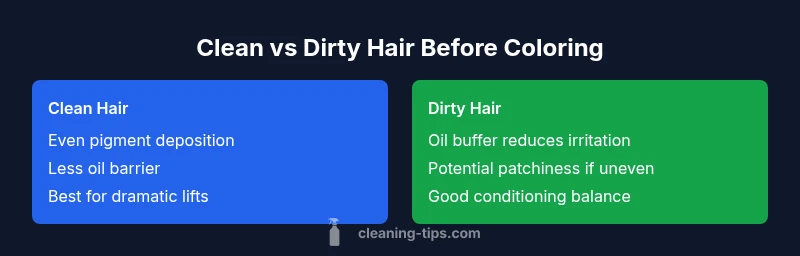
Clean or Dirty Hair Before Coloring: A Practical Comparison
Compare clean vs dirty hair before coloring to understand pigment uptake, scalp comfort, and practical prep steps. Learn how hair state affects results, with expert guidance from Cleaning Tips for DIY color and salon services.


According to Cleaning Tips, choosing between clean or dirty hair before coloring depends on your color goals, formula, and scalp sensitivity. For most at-home and salon color jobs, unwashed or lightly washed hair can yield gentler color uptake, while freshly washed hair may deposit pigment more evenly but can irritate sensitive scalps. The detailed comparison below helps you decide which approach fits your situation.
Clean or Dirty Hair Before Coloring: Core Factors
Choosing between clean or dirty hair before coloring sets the stage for pigment uptake, evenness, and scalp comfort. While the phrase clean or dirty hair before coloring is often discussed in salons and DIY guides, the reality is nuanced: the right choice depends on your hair condition, porosity, and the specific dye you’re using. The Cleaning Tips team emphasizes that there isn’t a single perfect rule; instead, align hair state with color goals, product instructions, and your tolerance for scalp sensation. In general, the more you customize the prep to your hair's natural state, the more predictable the result will be, particularly for dramatic shades or bond-building formulas. This section outlines how to interpret “clean” versus “dirty” in color terms and why that choice matters for your color result.
Defining 'Clean' and 'Dirty' Hair in Color Context
The terms clean and dirty are simplifications that reflect how much oil, sebum, or conditioner sits on the hair shaft and scalp. Clean hair typically means freshly washed with minimal styling products. Dirty hair can range from lightly oily to visibly coated with conditioners or serums. The choice affects how pigments deposit and how evenly they distribute along the strand. The goal is not to reach an absolute state but to match the hair’s surface condition with the dye’s chemistry. For many color formulas, especially ammonia-based permanent dyes, a hair surface with some natural oils can balance comfort and pigment adherence. Cleaning Tips notes that following product directions while considering your own hair’s baseline is key to success.
Porosity, Scalp Health, and Pigment Uptake
Hair porosity—how open the cuticle lies—governs how quickly color enters and how long it stays. Clean hair can make high-porosity strands absorb color more uniformly, while an ordinary amount of oil on the scalp can help protect delicate skin during processing. Dirty hair tends to have an oil layer that can slow or unevenly distribute pigment, especially at the roots where product meets the scalp. The practical takeaway: assess porosity and sensitivity first, then decide whether to wash, skip washing, or perform a quick clarifying wash a day or two before coloring. This helps ensure consistent results across lengths and ends.
The Chemistry: How Oils Influence Pigment Absorption
Oils on the hair surface alter the interface between dye molecules and the cortex. Clean hair removes this barrier, which can lead to faster uptake and sometimes stronger lift for lightening, but it can also cause uneven absorption if the cuticle is not intact. A light layer of oil at the scalp or ends can dampen irritation and improve conditioning but may hinder deep penetration for certain color formulations. The balance is product-specific: some formulas tolerate oils better than others. When in doubt, perform a strand test with the exact product to see how your hair state affects absorption.
Color Type Differences: Permanent, Demi, Semi, and Temporary
Different color categories interact with hair state in distinct ways. Permanent dyes rely on robust penetration and consistent porosity, which can benefit from a hair surface that is not overly clogged with product. Demi and semi-permanent colors are more forgiving of surface differences but still require predictable uptake. Temporary colors largely sit on the surface, so the presence of oils or residue can dramatically affect how vibrant the shade appears. Your choice of wash state should align with the color’s intended longevity and the desired level of strand conditioning.
The Role of Pre-Color Treatments: Bond Builders and Clarifiers
Bond builders, clarifiers, and deep conditioners influence how clean or dirty hair before coloring should be approached. If your goal includes bond protection (e.g., to safeguard against breakage during processing), using a bond builder with clean hair can be beneficial, provided you follow directions. Clarifying shampoos remove buildup that might impede color, especially after heavy styling products. In contrast, heavy conditioning near the roots can cushion the scalp but might reduce color uptake on the strands. The key is to balance cleansing, conditioning, and color chemistry for your specific product.
Step-by-Step Prep for DIY Color at Home
A practical prep protocol begins with an honest assessment of hair cleanliness. If your hair is very dirty or has heavy product buildup, start with a gentle clarifying wash and skip heavy oils on the scalp. If you have normal hair that’s not recently washed, a light rinse or scrub can help remove surface residue without stripping protective oils. Always perform a strand test before committing to full-head color. Ensure you have all tools ready (gloves, old towels, timer) and follow the dye’s processing times exactly. If you’re uncertain, contact a professional for guidance.
Salon Scenarios: When to Trust the Pros
In-salon color services often begin with a professional assessment of hair state. Stylists may adjust formulations based on whether the hair is clean or has a light oil barrier. They may also apply barrier protection at the scalp to reduce irritation while keeping the ends accessible for pigment. For those with sensitive scalps, a stylist might opt for a semi-permanent color or a bond-protecting treatment, especially if the goal is a precise shade or a dramatic lift. The takeaway is that salon results benefit from professional judgment about hair state and recommended products.
Practical Guidelines by Color Goal: Lightening vs. Depositing Color
If your goal is lightening, clean or lightly washed hair can yield faster lift, but you risk uneven texture if the scalp is irritated or if the cuticle is compromised. For depositing color, a slightly oily surface may help lock in pigment and reduce dryness after processing. For vivid shades, your colorist may prefer a controlled wash prior to application to ensure even uptake. Always adhere to the dye’s instructions and consider a patch test to evaluate any adverse reactions before full application.
Troubleshooting Patchiness, Overprocessing, and Patchy Roots
Patchiness often arises from inconsistent surface conditions. If roots appear lighter or darker than mid-lengths, evaluate whether the hair near the scalp had a different state (clean vs. oily) during application. Overprocessing can occur when the dye sits too long on an overly clean scalp, especially with high-lift formulations. In such cases, a neutralizing or conditioning treatment after color can help even out tone. If patchiness persists, consult a professional to assess porosity, product choice, and processing time.
Aftercare: Maintaining Color on Different Hair States
Post-color care is essential for maintaining even tone, whether you colored clean or dirty hair before coloring. Use color-safe shampoos and conditioners, heat protection, and regular deep conditioning to support the hair’s moisture balance. If you started with unwashed hair, consider a clarifying wash between color sessions to minimize product buildup. Keeping the scalp healthy and the cuticle smooth extends color life and reduces the risk of dull or uneven fading.
Comparison
| Feature | Clean hair before coloring | Dirty hair before coloring |
|---|---|---|
| Oiliness impact on pigment uptake | Oil-free scalp supports more predictable pigment deposition | Oil layer can slow absorption and create uneven results |
| Evenness of color uptake | Typically more uniform on clean hair across roots and lengths | Patchiness can occur where oils are unevenly distributed |
| Scalp comfort and irritation risk | Lower oil exposure may increase perceived irritation for sensitive scalps | Natural oils can buffer irritation but may complicate deposition |
| Color longevity and fade | Generally even fade on clean hair when using proper aftercare | Oil presence can subtly influence how color fades over time |
| Pre-color treatments | Clarifiers or bond-builders often used with clean hair | Oil-sensitive approaches may require adjustments to conditioning steps |
| Best for | Lightening, strong lift, or vivid shades with precise deposition | Coloring goals that benefit from conditioning and scalp buffering |
Strengths
- Potential for more predictable color deposition when hair is prepared to match formula
- Greater control over lift and saturation with product-guided prep
- Clear guidelines from product instructions plus professional tips improve outcomes
Weaknesses
- Risk of scalp irritation on freshly washed hair for sensitive individuals
- Possible patchiness if surface conditions are inconsistent across the head
- Extra steps may be needed (clarifying, conditioning) that could influence timing
Context-driven choice; neither state is universally better
For most color jobs, aligning hair state with product guidance yields the best balance of coverage and scalp comfort. The Cleaning Tips team emphasizes tailoring prep to your formula and hair type, with a preference toward controlled conditions for dramatic shades.
Questions & Answers
Should I color on hair that is freshly washed?
Not always. Freshly washed hair can deposit color evenly in some formulas, but it may increase scalp irritation for sensitive individuals. If you’re unsure, wait 12–24 hours or perform a strand test with the exact product.
Freshly washed hair can work for some dyes, but if your scalp is sensitive, a quick strand test or brief waiting period helps prevent irritation.
Can coloring dirty hair help with scalp sensitivity?
Oil can buffer irritation for certain people, but too much oil may hinder pigment uptake. If scalp sensitivity is a concern, discuss with your colorist, and consider a bond-friendly formula or a patch test.
Oil can help with irritation for some, but too much oil may reduce color uptake—patch test first.
Does the type of dye affect whether clean or dirty hair is better?
Yes. Permanent, demi-permanent, semi-permanent, and temporary colors interact differently with surface conditions. Always follow the dye’s directions and consider a strand test to see how your hair state influences results.
Different dye types react differently to hair state—check the box and test first.
What preparation steps are safe for DIY coloring?
Begin with a light cleansing if buildup is present, then avoid heavy oils near the scalp. Do a strand test, prepare all tools, and follow the processing times closely. If in doubt, seek professional guidance.
Clean lightly if there’s buildup, test a strand, then follow the label for timing.
How long should I wait after washing before coloring if hair is color-treated?
Follow the product guidance; typically waiting 24–48 hours after washing can be advisable for color-treated hair to ensure a stable base and reduce irritation.
Check the packaging, but many color-treated cases benefit from waiting a day or two.
Is it okay to condition hair before coloring?
Light conditioning can prep and protect, but avoid heavy conditioners exactly at the roots unless the dye instructions permit it. Some formulas prefer minimal residue to maximize deposition.
Condition lightly and follow the product’s guidance; avoid heavy root conditioning if not advised.
The Essentials
- Assess hair porosity and scalp sensitivity before choosing a state
- Follow the dye's instructions and perform a strand test
- Choose clean or slightly oily prep based on color goal and formula
- Use appropriate pre-color treatments to support desired results
- Post-color care is essential to maintain even tone