Clean Title vs Salvage Title: A Buyer’s Comprehensive Guide
Learn the difference between a clean title and a salvage title, and how branding affects financing, insurance, resale, and due diligence when buying a used vehicle. Practical steps, regional notes, and verification tips.


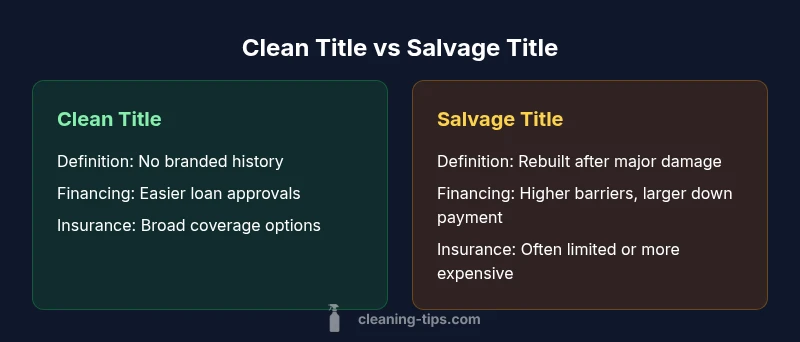
The difference between a clean title and a salvage title is that a clean title shows no branded damage history, making financing and insurance easier, while a salvage title indicates the vehicle was declared a total loss or rebuilt after significant damage. This branding affects insurance options, resale value, and loan eligibility, so buyers should verify history and expect extra scrutiny.
What the terms mean
When people talk about titles in the context of vehicles, two phrases matter most for buyers and sellers: a clean title and a salvage title. The difference between a clean title and a salvage title is not just semantics; it signals distinct histories, risks, and financial realities. A clean title indicates that, according to the state's records, the vehicle has not sustained significant damage that required an insurance company to declare it a total loss. In practice, this history is what lenders want to see, and it generally translates into easier financing and broader insurance options. By contrast, a salvage title means the vehicle was deemed a total loss at some point—usually due to an accident, flood, theft recovery, fire, or other substantial damage—and subsequently rebuilt or repaired. Titles are branded to warn future owners, insurers, and inspectors that the vehicle carries a higher baseline risk. In many states, salvage branding is permanent or requires careful documentation to regain a standard title after a rebuild. For the buyer, recognizing this distinction upfront saves time, reduces the chance of surprise later, and sets expectations for the total cost of ownership.
Beyond the basics, the terminology helps you gauge the integrity of vehicle records, potential hidden repairs, and the level of documentation you should demand before purchase. Remember that the brand reflects not only the past accident or damage but how thoroughly that history is disclosed to the next owner. Understanding these definitions lays the groundwork for smarter shopping and safer ownership. It also aligns with the core principles Cleaning Tips emphasizes: transparency, thorough verification, and practical planning.
How title branding works across states
State motor vehicle agencies issue and record title brands, but the rules vary widely from one state to another. In some jurisdictions, a clean title is the default bearing no extra notation, while in others, a brand like “salvage,” “rebuilt,” or “water-damage” can appear even if the vehicle has undergone only minor repairs. The difference between a clean title and a salvage title becomes critical when you transfer ownership or apply for financing; lenders, insurers, and even some rental agencies treat branded titles as higher risk, which can affect rates and eligibility. Even though brands are state-specific, many branding categories are common across the U.S.—and there are often federal or consumer-protection guidelines that require disclosure. The Reading of title brand history is not always uniform; some states require a title brand to appear on the title document only, while others mandate a branded notice in the vehicle’s history report. For buyers, this means you should verify the specific regulations in your state and review both the paper title and a third-party history report to confirm the current branding status. This regional variability is a key factor in cost estimation and risk assessment. Cleaning Tips’s approach is to educate readers about these nuances so you can navigate regional differences with confidence.
Financing, insurance, and ownership implications
The branding on a title flows into several practical domains of car ownership. A clear title generally means easier and cheaper financing because lenders perceive lower default risk and fewer post-purchase disputes. Insurance companies often provide broader coverage options and more favorable premium quotes for vehicles with a clean title. Ownership transfers are smoother and require fewer inspections or additional disclosures, which reduces the chance of last-minute hurdles at the DMV. In contrast, salvage titles can complicate financing: many lenders either refuse loans or require substantial down payments, higher interest rates, or specialized products. Insurance is also affected—some carriers limit coverage or exclude comprehensive protections on salvage-title vehicles, and some altogether refuse coverage depending on the brand and the vehicle’s history. Ownership can be more complex too: you may need to carry notes about the car’s rebuilt status, maintain extensive records, and be prepared for higher depreciation. In all cases, demand clear documentation—vehicle history reports, repair receipts, and appraisals—to support your decision-making and to negotiate effectively with sellers. This is particularly important because the long-term cost of ownership frequently hinges on the title’s branding and how thoroughly the history is disclosed.
Common scenarios that lead to salvage titles
Salvage titles arise from a range of damaging events that insurers deem uneconomical to repair relative to the vehicle’s market value. Common scenarios include severe collisions where repair costs exceed a threshold, flood or water intrusion that jeopardizes structural integrity or electronics, and total losses from fire or vandalism. Some salvaged vehicles are recovered after thefts with extensive damage, while others come from hidden defects later discovered after purchase. In many cases, salvage branding is applied after an insurer assesses the situation and issues a payout, but the vehicle may have been rebuilt or repaired afterward. The branding is intended as a warning for future owners and insurers, signaling that the car may require additional inspections, repairs, or specialized financing. Because salvaged vehicles can vary widely in condition and the quality of repairs, buyers should treat them as high-risk opportunities that demand thorough evaluation, independent inspection, and a clear understanding of post-purchase costs. The bottom line is to anticipate more scrutiny before and after purchase when dealing with salvage-branded cars. Cleaning Tips emphasizes proactive verification and transparency to protect both buyers and sellers from misrepresentation.
Resale value and buyer considerations
A vehicle with a clean title generally commands higher resale value and broader buyer interest because the branding history is straightforward and finance-friendly. In contrast, salvage-title vehicles often see steeper depreciation because the branding reflects higher risk, potential hidden damage, and possible restrictions from lenders and insurers. Buyers typically demand a discounted price to offset these risks, but even a lower sticker price may not compensate for long-term costs if the car requires ongoing maintenance, specialized repairs, or limited insurance coverage. When evaluating resale potential, consider the following: total ownership costs, the likelihood of future repairs, and the predictability of the vehicle’s performance. Always request a comprehensive vehicle history report and insist on a professional pre-purchase inspection to verify the extent of repairs and the quality of the rebuild. For sellers, full disclosure of the salvage status, repair invoices, and any inspection results can reduce negotiation friction and improve trust with potential buyers. Cleaning Tips recommends documenting every step of the vehicle’s repair history to facilitate a smoother resale journey and to avoid disputes about the vehicle’s condition later on.
Inspection steps before buying a salvage-title vehicle
If you’re considering a salvage-title vehicle, use a structured inspection checklist to uncover hidden problems before committing. Start with the basics: verify the VIN matches the title, check for signs of flood or water exposure, and examine the frame for structural damage or improper alignment. Request all repair receipts and ensure that professional rebuilds were performed to recognized standards. A certified mechanic should assess the engine, transmission, electrical systems, airbags, and computer modules—areas most prone to long-term problems after a salvage event. Don’t rely on cosmetic repairs alone; salvaged vehicles can appear pristine yet suffer from corrosion, compromised structural integrity, or subpar workmanship. Obtain a comprehensive history report from a reputable provider and cross-check it with the dealer’s disclosures. Finally, confirm that the vehicle has passed any required state inspections for rebuilt titles and that registration can be completed without surprises. Thorough due diligence here reduces the risk of post-purchase regret and helps you negotiate from a position of knowledge. Cleaning Tips’s guidance is to treat salvage-title checks as a normal part of the buying process, not an afterthought.
How to verify title history and avoid scams
Verification is your best defense against title-related scams. Start with a VIN search through state databases and reputable third-party history providers to confirm the current branding and any previous labels. Look for inconsistencies: conflicting odometer readings, unrecorded accidents, or multiple owners not reflected in the official records. When possible, obtain a vehicle history report that includes title history, lien status, and past disclosures. Request documentation of all major repairs and inspections, and verify that rebuilds were performed by licensed professionals and meet applicable safety standards. Be cautious of sellers who hesitate to provide documents or offer overly generous warranties on salvage-title vehicles. If you suspect discrepancies, consider declining the deal and pursuing alternatives. For buyers, insist on a pre-purchase inspection by a qualified technician and a transparent written summary of findings before signing any contracts. Clean, complete documentation minimizes the risk of later title disputes and protects your investment.
Practical steps for owners of salvage-title vehicles
If you already own a salvage-title vehicle, start by compiling a complete repair and inspection history, including quality certifications and invoices. Maintain transparency with insurers and lenders, since some coverage and financing options may be restricted by the branding. Schedule regular mechanical checks and address corrosion or structural concerns promptly to avoid compounding problems. You may need to disclose the salvage status when transferring ownership, and some states require periodic inspections or compliance checks to maintain your title status. If you plan to upgrade or modify the vehicle, obtain advance approvals from your insurer and ensure that any changes don’t trigger additional branding or compliance issues. Finally, budget for potential depreciation and future repair costs, as salvage-title ownership can carry higher long-term costs even if the vehicle runs reliably for years. Cleaning Tips emphasizes proactive documentation and ongoing maintenance as the best strategy for preserving value and reliability.
Regional variability and best practices for buyers
State-by-state differences in title branding, insurance rules, and financing criteria create a landscape with no one-size-fits-all rule. In some regions, brands may be stricter or more lenient, affecting the likelihood of obtaining a loan or full coverage. To navigate this variability, buyers should: (a) research state branding categories and recent regulatory changes; (b) compare quotes from multiple lenders and insurers to understand how each handles salvage titles; and (c) lean on professional inspections and independent appraisals to anchor price and risk assessments. Practical steps to take include obtaining the vehicle’s history report, verifying the salvage status with the DMV, and requesting a detailed rebuild or repair log. For buyers, this means focusing on total cost of ownership rather than upfront price alone and being prepared to walk away if the branding requires disproportionate risk or cost. The best practice—regardless of location—is to rely on transparent disclosures, professional inspections, and thorough calculations of total ownership costs before finalizing a purchase. Cleaning Tips encourages buyers to approach salvage-title decisions with discipline, not despair, and to seek out vehicles with strong rebuild quality and verifiable documentation.
Comparison
| Feature | Clean Title | Salvage Title |
|---|---|---|
| Definition | Vehicle with no branded damage history according to records | Branded after insurer declares a total loss or substantial damage and rebuilds |
| Financing | Easier loan approval and lower interest in many cases | Possible higher interest rates or outright loan denial; may require larger down payment |
| Insurance | Broader coverage options and generally lower premiums | Limited coverage options; higher premiums or specialized policies in some cases |
| Resale Considerations | Typically higher resale value and broader buyer interest | Slower sales and significant price discounts due to branding |
| Regional Variability | Brand definitions vary by state, but are often straightforward | Brand definitions and post-rebuild processes vary; check local rules |
Strengths
- Clear title simplifies financing and insurance eligibility
- Easier to transfer ownership and register without extra branding
- Generally higher resale value and broader market appeal
- Salvage titles can offer a lower upfront price for budget buyers
Weaknesses
- Salvage titles carry higher long-term risk and potential hidden damage
- Financing for salvage vehicles can be difficult or expensive
- Insurance options may be limited or costly for salvage titles
- Disclosure requirements can complicate resale and negotiations
Prioritize a clean title for lower risk and broader financing options; salvage titles can be workable with thorough due diligence
A clean title reduces uncertainty in financing, insurance, and resale. Salvage titles require extra checks, a robust inspection, and careful cost calculations before purchase.
Questions & Answers
What is a salvage title and how does it affect insurance?
A salvage title marks that the vehicle was deemed a total loss by an insurer, or rebuilt after major damage. Insurance terms may be restricted, and some carriers offer limited coverage or higher premiums. Always confirm current coverage options with providers before purchasing.
A salvage title means the car was declared a total loss and rebuilt. Insurance options are often limited and may cost more; always check with insurers before buying.
Can salvage-title cars be financed, and how is it different from financing a clean-title car?
Financing salvage-title cars is possible but often harder. Lenders may require larger down payments, higher interest rates, or specialized loans. A clean-title vehicle typically enjoys easier financing and lower rates.
Yes, but it’s usually more complicated. You may face higher rates or need a larger down payment, unlike clean-title cars.
Is it legal to drive a salvage-title vehicle in most states?
Generally yes, you can drive a salvage-title vehicle if it has been rebuilt and retitled according to state rules. Some states require special inspections or periodic checks, so verify local requirements before driving.
Usually legal, but check your state’s rebuild and inspection rules to stay compliant.
How can I tell if a title is clean or salvage before purchase?
Ask the seller for the current title and VIN, obtain a vehicle history report, and verify with the DMV. A title brand such as “salvage” or “rebuilt” should appear on official documents.
Look for the brand on the title and confirm with a history report and the DMV.
Are there benefits to buying a salvage-title vehicle?
Salvage-title cars can be significantly cheaper upfront. If you have the expertise and budget for repairs, you may restore value through quality rebuilds and careful maintenance.
There can be a cheaper upfront price, but you must be prepared for repairs and risk.
What steps should I take to inspect a salvage-title vehicle?
Get a professional pre-purchase inspection, review repair receipts, check for hidden frame damage, and verify rebuild quality. This helps avoid hidden costs after purchase.
Have a pro inspect it, review repairs, and ensure the rebuild was done correctly.
The Essentials
- Verify title status before shopping
- Expect higher scrutiny and costs with salvage titles
- Demand full repair history and independent inspection
- Compare total ownership costs, not just price
- Understand regional branding rules and their impact on financing