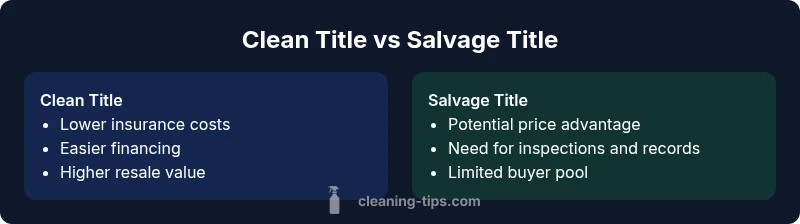
Clean or Salvage Title: A Practical Comparison for Car Buyers
Explore the differences between a clean title and a salvage title, including insurance, financing, and resale considerations, to make a smarter car purchase with practical checks and a clear decision framework.


If you’re weighing a vehicle’s history, the key difference is a clean title means no major damage reported, while a salvage title indicates substantial prior damage. The choice affects insurance, financing, and resale value. In this comparison, we evaluate costs, risk, and long-term value of clean title versus salvage title. Consider inspection outcomes, disclosures, and financing options to guide your decision.
Understanding the phrase clean or salvage title in car history
The phrase clean or salvage title describes two very different branding outcomes for a vehicle’s official record. A clean title indicates no major damage has been reported to the vehicle, while a salvage title typically means the car was declared a total loss by an insurer after damage or theft. Each label carries real-world consequences for insurance, financing, and resale. For readers of Cleaning Tips, the choice often hinges on how much risk you’re willing to accept and how you plan to use the vehicle. In practice, the difference affects upfront cost, loan eligibility, and how quickly the car moves in a competitive market. The goal of this article is to illuminate the practical implications of the phrase clean or salvage title with data-informed guidance. By focusing on title status, inspection options, and disclosure norms, you’ll be better prepared to evaluate every potential purchase shadowed by the phrase clean or salvage title. According to Cleaning Tips, a disciplined approach to title status helps protect your budget and safety on the road.
What the labels actually mean in practice
In everyday terms, a clean title indicates the vehicle has not sustained sufficient damage to be classified as a total loss by insurance. A salvage title is usually assigned after substantial damage, such as a severe collision, flood, or theft recovery, and may be paired with a later rebuilt title after repairs. While salvage titles are not automatically disqualifying, they signal higher risk and greater scrutiny from lenders and insurers. The terminology is standardized in many states, but the exact criteria and branding can vary. Understand that a rebuilt title is not identical to a salvage title; it represents a vehicle that has been repaired and retitled, which adds another layer of complexity to the purchasing decision. The upshot: clean or salvage title is not just a label—it’s a signal about history, disclosure, and the reliability of repair work. This section helps you interpret the labels you’ll encounter in listings and vehicle history reports, so you can assess whether the risk aligns with your budget and goals.
Insurance and financing implications of clean or salvage title
When you consider insurance and financing, the difference between a clean title and a salvage title becomes financially concrete. Clean title vehicles typically secure lower premiums because the risk profile is straightforward, and lenders view them as less volatile. By contrast, a salvage title often translates into higher insurance costs and stricter loan terms, including higher down payments or shorter loan durations. Based on Cleaning Tips analysis, buyers should expect greater scrutiny from insurers and lenders for salvage title vehicles, which can lead to higher total ownership costs even if the upfront price is attractive. If you’re financing, compare loan offers carefully and ask for an independent appraisal. For cleaners and refinancers, remember that a clean title is often a prerequisite for favorable terms, while salvage title ownership may require specialized coverage or a larger emergency fund for potential repairs. This section provides a practical framework for evaluating the financial consequences of clean or salvage title decisions.
Verification steps: VIN checks, Carfax, and title search
Verifying the title history is essential when you encounter a car with a potential clean or salvage title. Start with the VIN, then pull a full history report from reputable sources. Look for prior damage, flood exposure, lien releases, and any discrepancies between reported events and actual repairs. Ask the seller for documentation of repairs, inspections, and any rebuilt titles, and verify that the title brand shown on the report matches the physical title. In many markets, a professional inspection is a wise step when the vehicle carries a clean or salvage title flag. You should also confirm that certifications, appraisals, and repair invoices align with the claimed history. A thorough title check helps you move beyond marketing gloss and make a decision grounded in the vehicle’s verifiable past. The phrase clean or salvage title should be treated as a starting point for due diligence, not a guarantee of risk absence.
Costs and long-term ownership considerations
The cost implications of a clean or salvage title extend far beyond the asking price. With a clean title, you generally enjoy lower insurance premiums, more financing options, and steadier resale appeal, which translates into better total cost of ownership over time. A salvage title, if repaired and legally retitled, may still attract higher insurance premiums and reduce resale value, even after significant repairs. Cleaning Tips analysis indicates that the long-term cost difference often hinges on the quality of repairs, the extent of undisclosed damage, and the buyer’s ability to secure documentation. For buyers prioritizing budget, a clean title with a known repair history can be a better long-term bet than a salvage title flagged for potential hidden issues. Consider maintenance costs, potential future repairs, and the potential for reduced demand when you assess the total ownership cost of clean or salvage title vehicles.
Resale value and market perception
Resale value is a primary practical consideration when weighing clean or salvage title options. Vehicles with a clean title tend to command higher prices and face less buyer skepticism, particularly among first-time buyers and risk-averse buyers. Salvage title vehicles often face a thinner market, slower sales, and a lower ceiling on price, even after repairs, because buyers worry about hidden issues or lingering structural concerns. It’s essential to be transparent about any work performed and to provide complete repair records to offset some of the stigma associated with salvage title vehicles. If the goal is a quick turnover or a budget-friendly daily driver, salvage title ownership can be workable, but you should anchor expectations to market realities and prepare for longer listing times. This section highlights how resale value and market perception shape the ultimate decision between clean or salvage title options.
Legal and state variations
The legal framework surrounding title brands—including clean or salvage title—varies by state. Some states require explicit disclosure on the title and in history reports, while others permit different pathways for rebuilt titles and subsequent vehicle registrations. Before purchasing, check local DMV regulations about title branding, required inspections, and the legality of driving a rebuilt vehicle. If you’re relocating or purchasing from another state, confirm that the title brand transfers correctly to your state and that the vehicle passes any required inspections for registration. Knowing the state-specific rules reduces post-purchase surprises and minimizes the risk of discovering a non-transferable brand after the sale. Always treat the phrase clean or salvage title as a starting point for due diligence rather than the final word on a vehicle’s legality and safety.
Decision framework and buying scenarios
Making a decision with the phrase clean or salvage title requires a clear framework. Start with your budget and intended use: daily commuting vs. occasional travel, short-term ownership vs. long-term value. Run through the checklist: verify the title through official records, obtain a professional inspection, review repair documentation, compare financing options, and forecast total ownership costs. For buyers who value reliability and long-term peace of mind, a clean title generally offers fewer surprises and lower risk. If you must consider salvage title vehicles due to price or availability, insist on a rigorous inspection, a transparent repair history, a credible warranty, and a conservative budget for potential future repairs. The decision is a risk-reward calculation: clean titles typically win on predictability, while salvage titles can win on price with appropriate safeguards. Always document your decision steps and keep a clear record of all disclosures to safeguard against future disputes.
Authority sources
- Title branding and vehicle history basics — https://www.nhtsa.gov/vehicle-safety/title-branding
- Consumer guidance on salvage titles and buyer considerations — https://www.consumerreports.org/cars/what-to-know-about-salvage-titles/
- General auto safety and buying tips from a major publication — https://www.aaa.com
Comparison
| Feature | Clean Title | Salvage Title |
|---|---|---|
| Insurance cost | Lower premiums | Higher premiums and scrutiny due to risk |
| Financing availability | Easier approvals, flexible terms | Often restricted or require larger down payments |
| Resale value | Higher, broader buyer pool | Lower demand and slower sale |
| Disclosure and documentation | Clear branding, fewer surprises | Potential hidden issues; thorough records needed |
| Repair history transparency | Typically straightforward | Repair history may be incomplete or complex |
| Total cost of ownership | Lower long-term cost | Higher long-term risk if issues arise |
Strengths
- Lower long-term risk with a clean title
- Easier financing and insurance approvals
- Less resale friction and quicker marketability
- Better overall peace of mind for long-term ownership
Weaknesses
- Salvage-title vehicles can be priced attractively
- Repair histories may be incomplete or questionable
- Salvage titles can deter some buyers and lenders
Prioritize a clean title for long-term reliability; salvage titles can be workable with strict due diligence
A clean title generally provides more predictable ownership, easier financing, and higher resale value. Salvage titles offer price advantages but require rigorous inspection, transparent repair records, and a willingness to accept higher ownership risk. The right choice depends on your risk tolerance and planned use, with clean titles favored for long-term ownership.
Questions & Answers
What is the difference between a clean title and a salvage title?
A clean title indicates no major damage has been reported; a salvage title means the vehicle was declared a total loss by an insurer after significant damage. The labels influence insurance costs, financing options, and resale value. A thorough history check helps you assess true risk.
A clean title means no major damage; salvage title means the car was a total loss at some point. Both require careful checks before buying.
Can you insure a car with a salvage title?
Yes, but it often comes with higher premiums and more restricted coverage. Insurers may require disclosures, specialized policies, or additional inspections. Some providers may limit coverage until the vehicle passes a rebuild inspection or meets certain repair standards.
You can insure salvage title cars, but expect higher costs and possible coverage limits.
Is financing available for salvage-title vehicles?
Financing salvage-title cars is possible but less common. Lenders may demand higher down payments, shorter terms, or require a professional inspection and documented repair history. Comparison shopping is essential to find favorable terms.
Financing salvage-title cars is possible, but terms are often stricter and interest may be higher.
How does salvage title affect resale value?
Salvage-title vehicles generally fetch lower prices due to perceived risk, even after repairs. Transparent documentation and warranties can mitigate some concerns, but the market remains more limited than for clean-title cars.
Resale value tends to be lower for salvage titles, even with repairs.
What should I inspect before buying a salvage-title car?
Request complete repair records, obtain a pre-purchase inspection, verify airworthiness and safety features, and ensure all work complies with local regulations. A trusted mechanic can assess hidden issues that may not be obvious from history reports.
Get a full inspection and repair records before buying salvage titles.
Are rebuilt titles the same as salvage titles?
No. A salvage title indicates the vehicle was deemed a total loss. A rebuilt title means the vehicle was repaired and inspected to return to road use, with marketing of its rebuilt status. They carry different implications for insurance and financing.
Rebuilt titles come after repairs and inspections; salvage titles indicate prior total loss.
The Essentials
- Prioritize a clean title for reliability and resale value
- Inspect any salvage-title vehicle thoroughly before purchase
- Expect higher insurance and stricter financing with salvage titles
- Maintain complete repair records to support transparency
- Use a clear decision framework to compare total ownership costs