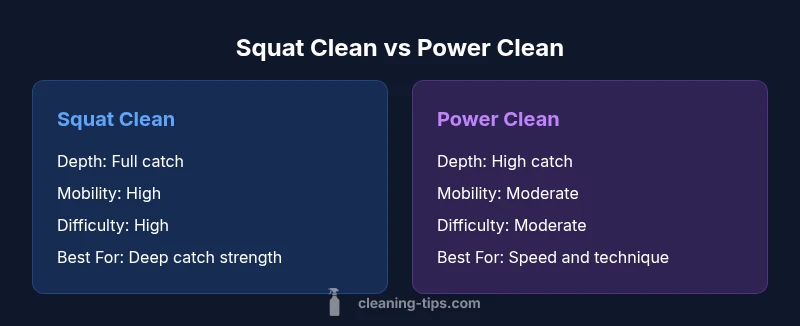
Is Squat Clean Harder Than Power Clean? A Side-by-Side Look
Analytical comparison of squat clean vs power clean, focusing on depth, mobility, learning curves, and training goals to guide lifters in choosing where to invest their time.


The squat clean and power clean share core mechanics, but depth and mobility demands make the squat version harder for most lifters. The power clean typically offers a shorter learning curve with quicker progression to heavier loads. This side-by-side comparison highlights the key factors that should guide training choices, including depth demands, mobility needs, and programming implications.
The Core Question: Is squat clean harder than power clean?
Is squat clean harder than power clean? The answer hinges on depth, mobility, and the complexity of the catch. A squat clean requires the lifter to drop into a full squat to receive the bar, then stand tall, which demands ankle dorsiflexion, hip mobility, and core control. By contrast, the power clean finishes the pull with a higher catching position, reducing depth requirements and often smoothing bar path. According to Cleaning Tips, understanding these mechanical differences helps trainees decide where to invest training time. This article analyzes both lifts across biomechanical demands, programming implications, and coaching cues to help lifters align goals with practical, evidence-informed practice. For many athletes, the squat clean demands greater ankle and hip mobility and a more demanding catch, which can make timing and footwork more challenging. Yet the squat clean also builds a robust catch position that translates into strength cycles and athletic versatility.
Movement Fundamentals: squat clean vs power clean mechanics
Both lifts rely on a rapid, coordinated sequence: a powerful first pull, an explosive second pull, and a controlled catch. The squat clean emphasizes a deeper catch and a stronger base under the bar, which requires precise bar path control and a stable trunk through the squat. The power clean prioritizes a higher catch, which can shorten transition time and reduce the complexity of footwork. Understanding the biomechanical differences helps coaches tailor cues and progression plans. In practice, most lifters experience a more forgiving learning curve with the power clean, especially when mobility is a limiting factor. Over time, both lifts reinforce triple extension, but the squat clean magnifies the demands on hip flexion, ankle mobility, and thoracic stability.
Depth and Mobility Demands
Depth is the defining difference between the two lifts. The squat clean requires a full-depth catch, typically below parallel, which places higher demands on ankle dorsiflexion, hip crease mobility, and thoracic extension. If mobility is limited, lifters may compensate with facial expressions, bar drift, or early upright torso angles, which degrade efficiency and increase injury risk. The power clean allows a higher catch, reducing depth requirements and allowing a more upright torso at catch. However, this comes at the cost of potentially less core engagement in the bottom position and different bar path dynamics. Mobility work—calf and ankle ROM, hip openers, thoracic mobility—yields the biggest dividends for those aiming to master the squat clean.
Learning Curve and Technique Acquisition
The learning curve for the squat clean is steeper than for the power clean, primarily due to the depth and foot positioning demanded at the catch. Beginners often struggle with simultaneous depth, hip timing, and bar path. Effective progression starts with pulling and catching in a high pull or tall-clean progressing to a mid-depth catch, then advancing to full-depth catches. The power clean can be introduced earlier, focusing on bar path and rack position before integrating deeper catches. Coaching cues like soft landings, active lats, and precise foot placement help athletes internalize efficient mechanics more quickly. Remember that the rate of improvement depends on mobility, core stability, and consistent practice.
Strength Transfer and Training Implications
Strength transfer from cleans depends on depth and catch position. The squat clean tends to place greater emphasis on quadriceps, glutes, and hip extensors through the full catch, supporting solid base strength and leg drive through larger ranges of motion. The power clean emphasizes explosive triple extension and back strength, with a smoother transition into the upright catch that benefits sprinting and Olympic lifting speed. For athletes focusing on maximal strength in the squat or improving general athleticism, the squat clean is often a superior transferrer. For those prioritizing rate of force development and technique density, the power clean can yield quicker, tangible gains early in a cycle.
Injury Risk and Safety Considerations
Both lifts carry typical barbell injuries—but the risk profile shifts with catch depth. The squat clean exposes lifters to greater knee and ankle stress if depth is forced or mobility is insufficient, and it can amplify thoracic stiffness if spine alignment deteriorates under load. The power clean reduces catch depth and often lowers the immediate risk of knee valgus in the catch, but it can increase wrist and elbow strain if rack position is poor. Proper warm-ups, mobility work, and progressive loading are essential for both lifts. Coaches should emphasize posture, bracing, and a controlled catch to minimize risk.
Programming Considerations: When to choose which lift
Program design should reflect goals, athlete experience, and access to equipment. If the objective is maximal leg and hip strength with a focus on stable catch mechanics, the squat clean is advantageous, especially in phases targeting hypertrophy or generalized athleticism. If the goal is movement economy, speed, and skill acquisition, the power clean provides a smoother entry point for many athletes. Periodization often pairs the two lifts to exploit complementary adaptations: one cycle emphasizing depth and catch stability (squat clean), followed by a cycle emphasizing bar speed and rack position (power clean). Coaches should adjust volume, intensity, and rest based on the lifter’s readiness and the training phase.
Equipment and Setup: bars, grips, and stance
A standard Olympic bar and bumper plates are sufficient for most cleans, but stance width and grip width can drastically affect technique. The squat clean benefits from a slightly wider stance to accommodate deeper squats and a more secure catch, while the power clean can use a narrower stance to reduce the distance to the bar path. Footwear matters: lifting shoes with an elevated heel help achieve better ankle position for the squat catch, whereas flat-soled shoes may suit lifters focusing on bar speed. Warm-up sets should include mobility drills for ankles, hips, and thoracic spine, plus progressive loads to acclimate the body to the demands of both lifts.
Common Faults and How to Fix Them
Common faults include shallow catches, bar drift, and mistimed triple extension. In a squat clean, faults often arise from late hip initiation or a failing to maintain upright chest through the catch. Cue corrections like “catch deeper, stay tall, chest up” and practice with paused squats under the bar can improve stability. In the power clean, faults commonly involve catching too high or losing rack position, which can be addressed by working on full-range pulls, then practicing high catches with light loads. Drills like drop catches, tempo pulls, and drop jerks can reinforce correct mechanics. Consistent coaching cues and video analysis help lifters self-correct between sessions.
Case Scenarios: Goals, lifters, and constraints
A competitive weightlifter prioritizing competition performance may benefit from integrating both lifts, using the squat clean to build depth and grip strength while using the power clean to refine bar speed and rack stability. A general strength athlete focused on overall athleticism might emphasize the squat clean for its transfer to hip drive and leg development, while incorporating the power clean to maintain sprint-like speed and rhythm in the bar path. A busy recreational lifter with mobility limitations could start with the power clean to build confidence and work on form before attempting deeper catches. The key is to adapt the coaching cues and progression to each lifter’s mobility, goals, and time constraints.
Progression Path: From Power Clean to Squat Clean
For lifters who start with the power clean, a sensible progression toward the squat clean involves staged depth targets, mobility work, and a structured velocity program. Begin with power cleans from mid-thigh up to a high catch, then gradually work toward lower catches as mobility improves. Integrate paused or tempo cleans to reinforce positions, followed by full-depth catches with lighter loads while maintaining technique. Schedule deloads and technique-focused sessions to avoid overuse injuries and ensure consistent technique development. Remember that progress is non-linear; track technique quality and mobility gains alongside load progression for best results.
Decision Framework: Quick rules of thumb for coaches and athletes
When deciding between lifts, consider depth tolerance, mobility readiness, and long-term goals. If mobility is limited or the athlete is early in the learning curve, start with the power clean to establish bar speed and rhythm. If the aim is maximal strength with a robust catch, allocate time to mastering the squat clean, even if it means slower initial progress. A balanced program often uses both lifts in different blocks to diversify stimulus while supporting overall athletic development. Above all, prioritize technique, mobility, and progressive loading to minimize injury risk and maximize transfer to sport-specific performance.
Comparison
| Feature | Squat Clean | Power Clean |
|---|---|---|
| Depth / Catch Position | Full-depth squat catch (below parallel) | High catch with partial depth |
| Mobility Demands | Higher ankle/hip mobility required | Lower mobility threshold; easier to learn |
| Learning Curve | Steeper; depth and footwork complexity increase difficulty | Gentler; faster to pick up bar path and rack position |
| Bar Path Consistency | More challenging path control due to deeper catch | Typically more linear path and quicker stabilization |
| Strength Transfer | Greater emphasis on leg drive; strength at deep catch translates to versatility | Explosive power and upper-body timing; faster early gains |
| Best For | Athletes aiming for maximal leg/base strength and deep catch mechanics | Lifters prioritizing speed, technique density, and quicker progress |
| Injury Risk Profile | Greater knee/ankle load with deep catch; risk rises with limited mobility | Lower depth reduces some knee risk but can stress wrists and elbows if rack is poor |
| Programming Implications | Often deeper cycles; strength-focused blocks | Speed and technique blocks; faster cycle progression |
Strengths
- Both lifts promote triple extension and total-body power
- Squat clean builds durable catch position for strength cycles
- Power clean offers faster initial progress and easier learning curve
- Both lifts enhance hip drive, core stability, and athletic transfer
Weaknesses
- Squat clean demands greater mobility and technique complexity
- High-depth catches can increase fatigue and injury risk if mobility is limited
- Power clean may emphasize speed over full-depth technique if rushed
- Programming requires careful progression to avoid overuse injuries
Power clean often offers a smoother entry; squat clean delivers deeper catch strength
Choose power clean to build early technique and speed; select squat clean when depth, leg drive, and catch stability align with goals. Use both strategically to maximize overall athletic development.
Questions & Answers
Is squat clean harder than power clean for beginners?
Yes, for many beginners the squat clean is harder due to the depth and mobility demands of the catch. The power clean is usually easier to learn and can serve as a gateway to more complex variations.
Yes. For beginners, the squat clean is typically harder because of the deep catch and mobility needed.
Which lift should a beginner start with?
Many beginners start with the power clean to learn bar path and rack position, then progress to the squat clean as mobility and technique improve.
Start with the power clean to learn form, then progress to the squat clean as you gain mobility.
What are common faults in the squat clean?
Common faults include shallow catches, poor bar path, early torso rise, and collapse under the bar. Fixes involve mobility work, paused catches, and targeted cueing.
Common squat-clean faults are shallow catches and bar-path issues; fix with pauses and mobility work.
How can I safely progress from power clean to squat clean?
Progress gradually: improve mobility, practice higher catch positions with light loads, then add depth while maintaining technique. Use progressive volume and monitor for early signs of strain.
Progress gradually with mobility work and light-load depth practice.
What equipment is essential for cleans?
A standard Olympic bar and bumper plates are essential; lifting shoes with an elevated heel can help achieve better ankle position in the squat catch.
Olympic bar, bumper plates, and lifting shoes with a heel are recommended.
How long does mastery typically take?
Mastery depends on mobility, strength, and practice frequency. Consistent coaching and video feedback accelerate progress more than raw volume alone.
Mastery varies; consistent coaching and feedback speed up progress.
The Essentials
- Assess mobility first before choosing depth-heavy lifts
- Power clean is generally easier to learn than squat clean
- Squat clean provides stronger catch mechanics and depth benefits
- Alternate blocks can balance speed, strength, and mobility gains