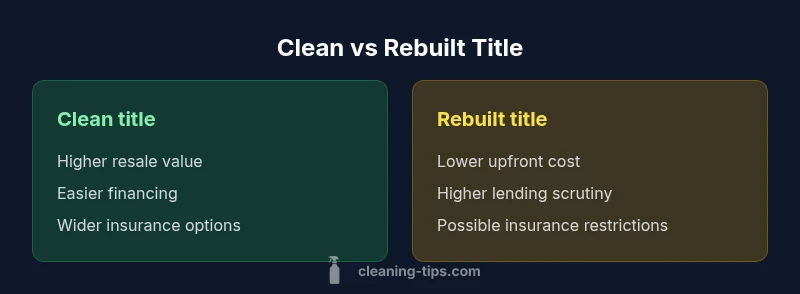
Clean vs Rebuilt Title: A Practical Buyer’s Guide to Titles
Compare clean titles and rebuilt titles to understand risks, costs, and how they affect buying, financing, and insurance. Learn verification steps and scenarios to guide your decision.


In used-vehicle markets, a clean title means no major damage history, while a rebuilt title indicates past damage that was repaired and inspected. The clean vs rebuilt title choice shapes price, financing options, and insurance availability. This quick comparison helps you identify which history fits your budget and risk tolerance, and what to verify before purchasing.
Defining the clean vs rebuilt title
A clean title is the default expectation for most buyers: it signals that a vehicle has no record of significant damage that required an insurance total loss designation. By contrast, a rebuilt title (often called a salvage title before repairs) reflects a history where the car sustained damage that was substantial enough for an insurer to declare it a total loss. After repairs and a state inspection, the vehicle can be issued a rebuilt title. This distinction matters not only for price, but also for financing, insurance, and resale because it directly affects perceived risk and verifiable history. According to Cleaning Tips, the terminology reflects a formal status rather than a subjective impression—rebuilt indicates a salvage event occurred, and the vehicle has undergone repair and safety checks. The broader implication is that buyers should scrutinize the specific repair work, parts quality, and the extent of post-collision testing rather than rely on the title badge alone.
How a clean title influences price and financing
A vehicle with a clean title typically commands a higher market value and broader lending options. When banks assess a loan, they weigh the risk of the title history because it correlates with resale confidence and potential hidden issues. A clean title often translates into lower interest rates and longer financing terms, which reduces the total cost of ownership over the life of the loan. In contrast, a rebuilt title can trigger a price discount that ranges from modest to substantial, depending on the vehicle’s make, model, year, and mileage. Lenders frequently impose stricter underwriting criteria on rebuilt-title purchases, sometimes requiring larger down payments, shorter terms, or mandatory inspections prior to final approval. For buyers, this means budgeting more for purchase costs and anticipated premiums, even if sticker prices appear attractive at first glance. Cleaning Tips analysis in 2026 notes that many buyers underestimate the total ownership cost when a rebuilt title is involved, especially once interest and insurance considerations are included.
What a rebuilt title signals and risks
A rebuilt title signals that a vehicle has endured significant damage and needed repair work before returning to the road. While some rebuilds are thorough and safe, others may conceal structural or systems issues that could surface later. The biggest risk is the potential for hidden frame damage, misaligned components, or substandard parts. Even when a vehicle seems mechanically sound, insurance claims history and repair quality can influence longevity, safety, and reliability. From a consumer perspective, a rebuilt title often attracts more skepticism from buyers and may invite higher maintenance costs, more frequent repairs, and a steeper depreciation curve. For this reason, it’s essential to obtain complete repair invoices, confirm component replacements, and consider independent inspections from a qualified technician before committing to a rebuilt-title purchase.
Title history checks: steps and best practices
Verifying the title history is a multi-step process designed to confirm authenticity and reveal any prior damage. Start with a formal vehicle history report from a reputable provider, then cross-check the Vehicle Identification Number (VIN) against state records for past titles and any salvage designations. Inspect the visible parts of the car for signs of improper repair or mismatched panels, listen for unusual engine noises, and test key safety systems such as airbags and braking efficiency. An independent mechanical inspection is highly recommended when a rebuilt title is involved. If a repair shop is uncertain about the origin of certain components, seek a second opinion. According to Cleaning Tips, thorough documentation and third-party verification reduce the risk of future disputes and help you make an informed decision. A careful review should also include an appraisal of how the title history could affect resale value and long-term costs.
Insurance implications and coverage options
Insurance for rebuilt-title vehicles varies by insurer and state. Some providers restrict coverage options or require higher deductibles, while others may offer standard liability and comprehensive coverage with adjusted premiums. It’s common to encounter rating factors that reflect increased risk, such as limited warranty options or shorter policy durations. If you plan to insure a rebuilt-title vehicle, contact multiple insurers to compare quotes and confirm whether any endorsements or specialized coverage are needed. Be prepared to provide detailed repair records and a recent inspection report. Cleaning Tips analysis highlights that proactive communication with insurers, transparency about the vehicle’s history, and documented repairs can streamline policy placement and mitigate surprises at claim time.
Resale value and buyer perception
Resale value for rebuilt-title vehicles tends to be lower than for clean-title cars, primarily due to stigma, perceived risk, and lender concerns. While some buyers react to price discounts with enthusiasm, many others remain cautious. The depreciation curve for rebuilt titles often plateaus at a lower level, and some buyers may avoid vehicles with rebuilt histories altogether. However, price sensitivity can create opportunities for well-priced units with transparent histories and robust repair documentation. A key strategy is to assemble a complete service history, including parts provenance and professional inspections, to demonstrate reliability and safety. The market response hinges on how convincingly you can document the vehicle’s post-repair performance and present a credible ownership narrative.
Practical decision framework: when to walk away
Develop a clear decision framework before negotiating. If the price gap between a clean-title and rebuilt-title vehicle is not justified by the repair quality, it may be wiser to walk away. Prioritize factors such as the credibility of the repair shop, the severity of the original damage, and the availability of a comprehensive warranty. In some cases, a rebuilt-title purchase can be justified for highly desired models with specialized features or limited supply, provided you have verified repairs and secured favorable financing. Always estimate total ownership costs over five to seven years, including maintenance, potential major repairs, insurance, and a possible depreciation hit at resale. A cautious approach helps you avoid overpaying for a rebuilt title while preserving affordability when the unit is well-documented and relied upon for daily use.
Common myths and misunderstandings
A common myth is that rebuilt-title cars are inherently unsafe. In reality, the safety of a rebuilt vehicle depends on the quality of repairs and the thoroughness of post-repair testing. Another misconception is that rebuilt titles automatically mean catastrophic failure; while risk is higher, it is not guaranteed. Some buyers worry that rebuilt titles can never be insured, which is false in many cases, though coverage terms may differ. Finally, some buyers assume that a rebuilt title will be instantly disqualified from ownership transfer; while some states impose restrictions, many jurisdictions allow transfer with proper disclosure and documentation. By separating myths from facts and relying on verified repair records, you can determine whether a rebuilt-title purchase makes sense in your situation.
Steps to take before you sign: a concise checklist
Create a pre-purchase checklist that includes a current vehicle history report, a verified salvage and repair claim trail, and an independent mechanical inspection focused on frame integrity and safety systems. Request all invoices and parts sources, and ensure parts match the vehicle’s VIN. Confirm the title status with the DMV, and check for any cosmetic discrepancies that might signal tampering or partial repairs. Compare insurance quotes, and assess total ownership costs given your financing terms. If anything feels uncertain, take extra time to consult a trusted mechanic or seek a second opinion. This disciplined approach can help you avoid overpaying for a rebuilt-title vehicle and minimize future surprises.
Maintaining clarity in future titles
If you purchase a rebuilt-title vehicle, maintain meticulous records to protect your investment: keep repair receipts, inspection reports, and warranties in a single, organized file. For future sales, present a transparent history with accessible documentation to reassure buyers. Consider scheduling routine maintenance and keeping service logs current to demonstrate ongoing reliability. As a practical matter, build a candid narrative around the vehicle’s past in your listing and be prepared to answer questions about how repairs were conducted and tested. This proactive transparency helps sustain trust with future owners and can improve negotiation outcomes when converting a rebuild into a smoother, value-conscious sale.
Comparison
| Feature | Clean title | Rebuilt title |
|---|---|---|
| Definition | No major prior damage history; no salvage designation | Vehicle previously declared a total loss due to damage; repaired and inspected; issued rebuilt/salvage title |
| Typical price impact | Higher market value and resale potential | Discounted price reflecting perceived risk and repair history |
| Financing availability | Widely available; standard terms and rates for many lenders | Fewer lenders; higher interest rates; stricter down-payment requirements |
| Insurance considerations | Standard coverage commonly available; broader policy options | Possible limits, higher deductibles, or special endorsements; premium impacts vary by insurer |
| Resale value | Traditionally stronger resale appeal | Lower resale value due to stigma and risk concerns |
| Disclosure and warranty | Disclosure typically straightforward; warranties depend on sale terms | Disclosure mandatory; warranty options may be limited; some repairs drive warranty decisions |
Strengths
- Cleaner title history often yields higher resale value
- Easier financing with standard loan terms
- Broader insurance options and potentially lower premiums
- More straightforward ownership narrative with verifiable history
Weaknesses
- Higher upfront price for clean-title vehicles
- Limited availability in certain markets or models
- Possible overpayment if the seller lacks complete records for rebuilt units
- For rebuilt titles, the chance of hidden issues without thorough inspection
Choose a clean title for predictability and broader financing; consider a rebuilt title only with solid documentation and a compelling price
A clean title generally offers better long-term value and lower risk. A rebuilt title can be acceptable if the price is convincingly lower and repair history is transparent and well-supported by records.
Questions & Answers
What exactly is a clean title and how does it differ from a rebuilt title?
A clean title indicates no significant past damage that led to a salvage designation. A rebuilt title means the car sustained substantial damage and was rebuilt and inspected before regaining road status. The distinction affects perceived risk, value, and insurance options.
A clean title means no major damage was recorded; a rebuilt title means the car was damaged, repaired, and re-verified before it could be driven again.
Can I still borrow money or get insurance for a rebuilt-title car?
Yes, but terms are often less favorable. Lenders may require higher down payments or shorter terms, and insurers may impose higher premiums or limited coverage. Shopping around and securing documentation helps improve outcomes.
Yes, but you may see higher rates and stricter terms; shop around for the best insurance and loan options.
What should I look for in the repair history of a rebuilt-title vehicle?
Seek comprehensive invoices, parts provenance, independent inspections, and a clear record of safety-system tests. A clean, verifiable history reduces risk and improves negotiation leverage.
Look for full repair records, part sources, and independent inspection reports.
Is it possible to convert a rebuilt title back to clean?
In most cases, a rebuilt title cannot be changed back to clean. You can improve its marketability by documenting high-quality repairs, obtaining ongoing service records, and ensuring the vehicle meets safety standards.
Usually not—rebuilt stays rebuilt, but you can improve its appeal with good records and inspections.
How much should the title history impact the price I offer?
The impact varies by model, market, and repair quality. A thorough history and professional inspection can justify a fair price difference; avoid overpaying relative to a clean-title option when the risk is uncertain.
Price should reflect risk, documentation, and the cost of potential repairs.
What myths should I ignore when evaluating a rebuilt-title vehicle?
Ignore claims that rebuilt titles are always unsafe or that insurance is impossible. While these beliefs are oversimplified, acknowledge the elevated risk and verify with documentation and inspections.
Don’t assume rebuilt means unsafe or uninsurable—verify with records and a mechanic.
The Essentials
- Prioritize titles with transparent repair history and complete documentation
- Expect better financing and insurance with a clean title
- Get independent inspections for rebuilt-title vehicles
- Compare total ownership costs, not just sticker price
- Ask for a detailed repair ledger and VIN-specific records
- Be cautious in markets with limited title history data