How to Check a Clean Title: Practical Cleaning Guide
Meta description: Learn how to check a clean title for cleaning content. This educational guide provides a step-by-step approach, examples, and a reusable checklist to ensure clarity, accuracy, and SEO relevance in your cleaning-related articles.


If you want readers to trust your cleaning guide, you need a clean title. A clean title clearly states the task, avoids jargon, and matches search intent. This guide shows a repeatable method for how to check clean title quality, including clarity, specificity, and essential keywords. By following these steps, you’ll reduce misclicks and improve your article’s relevance from the start.
Why a clean title matters in cleaning content
A clean title sets expectations and guides the reader toward actionable steps. When you publish a Cleaning Tips article, a well-crafted title helps users recognize immediately whether the content will solve their problem. For the keyword how to check clean title, the title should promise a concrete outcome and map to the reader's intent. A clean title also reduces bounce rates and improves accessibility. According to Cleaning Tips, titles that clearly express outcomes perform better across search and social platforms. In this section, you’ll learn how to check clean title quality and apply a repeatable process that works for most cleaning topics. A strong title should be testable, repeatable, and adaptable to different cleaning scenarios such as surface cleaning, appliance care, or eco-friendly routines.
In practice, your title should function as a roadmap. It tells readers what action to take, what result to expect, and how long it will take. When you master the art of a clean title, you empower your audience to decide quickly whether the article will help them meet a cleaning goal—whether it’s removing a stubborn stain, choosing the right cleaner, or achieving a healthier home environment.
What makes a title 'clean' in Cleaning Tips sense
A clean title is not the opposite of clickbait; it's the practical articulation of the task. In our practice, a clean title has five core attributes: clarity, specificity, credibility, conciseness, and consistency with the article's content. Clarity means the reader understands the outcome. Specificity means the title references a concrete action or result. Credibility requires avoiding exaggerated claims. The SEO angle matters: include a primary keyword near the start and avoid stuffing multiple keywords. For a Cleaning Tips article, linking the title to a tangible outcome—saving time, achieving a safer home, better hygiene—gives readers a reason to click and read. Finally, ensure the format is consistent with other posts in your series to build trust with your audience.
The criteria: clarity, specificity, and credibility
Clarity ensures the title states the task and the outcome. Specificity reduces ambiguity by mentioning a target or result, e.g., 'how to clean a stainless steel sink without streaks.' Credibility means not promising miracles; instead, set realistic expectations. The SEO angle matters: include a primary keyword near the start and avoid stuffing multiple keywords. For a Cleaning Tips article, linking the title to a tangible outcome—saving time, achieving a safer home, better hygiene—gives readers a reason to click and read. Finally, ensure the format is consistent with other posts in your series to build trust with your audience.
A clean title also aligns with accessibility guidelines. Screen readers benefit from concise phrasing, and search engines reward descriptions that accurately reflect the content. By focusing on clarity and honesty, you reduce the chance of misinterpretation and improve overall user satisfaction.
Step-by-step framework to check a title
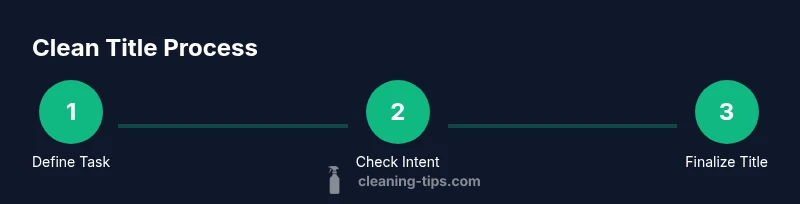
- Define the core task: Identify the exact task or outcome your article delivers. 2) Identify audience and intent: Consider what the reader wants to accomplish and what problem they are solving. 3) Extract primary keyword and assess relevance: Place the keyword near the start and ensure it matches the content. 4) Test for clarity and length: Read aloud, count characters, and compare to an ideal range. 5) Validate with search intent: Run a quick search query simulation to see if the title matches user intent. 6) Finalize and optional subtitle: Add a concise subtitle that reinforces the main outcome without duplicating the title.
This framework helps standardize how you approach every title, ensuring consistency across your Cleaning Tips content. When applied, it becomes a quick, repeatable habit rather than a one-off exercise.
Checklist you can reuse for every article
- Clarity check: Does the title reveal the exact outcome?
- Length check: Is it within a practical range (roughly 50-60 characters)?
- Keyword placement: Is the primary keyword near the start?
- Avoid hype words: Are terms like 'miracle', 'guaranteed' absent?
- Readability: Can someone with an 8th-grade reading level understand it?
- Alignment: Does the title match the content and the visuals?
- Uniqueness: Is the title distinctive within the topic?
Using this checklist before publication saves time in review and helps keep your content consistent with Cleaning Tips standards.
Examples: before and after titles
- Before: "Amazing cleaning tips you must try today"
After: "How to Clean Your Bathroom Sink Without Streaks: A Practical Guide"
Rationale: Adds a concrete outcome and decreases hype while keeping actionable promise. - Before: "Best ways to tidy your kitchen"
After: "How to Tidy Your Kitchen Surfaces in 15 Minutes: A Step-by-Step Plan"
Rationale: Specifies outcome, time, and process, improving clarity and SEO relevance. - Before: "How to check a title"
After: "How to Check a Clean Title: Practical Cleaning Guide"
Rationale: Uses the target keyword plainly and aligns with user intent for cleaning topics.
Integrating title checks into your publishing workflow
In practice, run the title through the checklist during the editorial review stage. Use a template to ensure consistency across posts. In your editorial calendar, reserve a 'Title Audit' step before final approval. Encourage authors to draft multiple title options and select the one that most clearly communicates the outcome. This habit improves efficiency, reduces revisions, and strengthens your channel's credibility. Regularly revisiting your title strategy also supports SEO by aligning with evolving search patterns and user intents in the cleaning niche.
Authority sources and further reading
- https://www.plainlanguage.gov/
- https://owl.purdue.edu/
- https://www.cdc.gov/
These sources provide guidance on plain language, readability, and clear communication—helpful foundations when refining cleaning-related titles for accuracy and accessibility.
Final notes on search intent and readability
A clean title is more than a catchy phrase—it is a precise promise about the content. Regularly validate your titles against real user questions and search queries in your niche. Use readability tools to ensure your text remains accessible, and test titles in small-scale A/B tests when possible. Keeping titles honest and user-focused not only helps readers but also strengthens your Cleaning Tips authority over time.
Tools & Materials
- Style guide(A standard set of rules used by your publication (e.g., brand voice, tone, capitalization).)
- Keyword research tool(Use to validate primary keyword and related terms.)
- Readability tool or plugin(Assess ease of reading (Flesch-Kincaid, etc.).)
- Checklist template(A reusable 1-page checklist for title review.)
- Editorial calendar access(To align with planned topics.)
Steps
Estimated time: 15-25 minutes
- 1
Define the core task
Identify exactly what action or outcome the article delivers. The title should reflect that outcome precisely, not a broader topic. This helps ensure readers know what they will accomplish.
Tip: Nail the verb that describes the action (e.g., 'clean', 'remove', 'improve'). - 2
Identify audience and intent
Consider who will read the article and what problem they want to solve. A title that matches intent reduces bounce and increases engagement.
Tip: Ask: What question would a reader type into a search bar to find this article? - 3
Extract primary keyword and assess relevance
Decide on the main keyword and place it near the start of the title. Ensure the keyword aligns with the article content and user expectations.
Tip: Avoid stray keywords that do not reflect the content. - 4
Test for clarity and length
Read the title aloud and count characters. Aim for a concise range (roughly 50–60 characters) for readability and SERP display.
Tip: If the title feels crowded, prune adjectives and compress verbs. - 5
Validate with search intent
Run a quick mock search to see if the title matches common user queries. Adjust wording to improve alignment with intent.
Tip: Use natural language, not overly technical jargon. - 6
Finalize the title and optional subtitle
Lock in the title, then add a brief subtitle that reinforces the outcome without duplicating content.
Tip: Subtitle can offer a secondary benefit or scope (time, method).
Questions & Answers
What defines a 'clean title' in cleaning content?
A clean title communicates the exact task, avoids sensational language, and matches user intent. It should be specific, testable, and aligned with the article's content.
A clean title clearly states the task and outcome, without hype.
How long should a clean title be?
Aim for roughly 50-60 characters to balance readability and search visibility. Shorter titles are easier to read on mobile and in search results.
Keep it around one line of text, about 50 to 60 characters.
Why is keyword placement important in a clean title?
Placing the primary keyword near the start improves visibility in search and clarifies the article’s topic for readers and machines alike.
Put the main keyword at the beginning for clarity and SEO.
Can a title include more than one primary keyword?
A title can include related terms, but prioritize a single clear primary keyword to avoid dilution. Use related terms in the subtitle if needed.
Stick to one main keyword; add others in the subtitle or body.
How often should titles be tested and revised?
Revisit titles whenever the article is updated or if analytics show low engagement. Regular audits help maintain alignment with evolving user intent.
Review titles with updates and performance data to keep them relevant.
The Essentials
- Define the exact task the article delivers.
- Prioritize clarity, specificity, and credibility.
- Place the primary keyword near the start.
- Keep titles concise for readability and SEO.
- Incorporate a consistent title format across posts.