Clean and Unclean Animals in the Bible: A Comparative Analysis
Explore the biblical categories of clean and unclean animals, their dietary and ritual roles, and how modern readers reinterpret these distinctions.


Clean and unclean animals in the bible differentiate ritual status and dietary rules rather than moral worth. The categories shape ancient worship, daily life, and covenant identity. This comparison surveys their origins, how they were observed in Leviticus and Deuteronomy, and how scholars and faith communities read these distinctions today. Understanding these terms helps explain why some animals were sacrificed, others avoided, and how later interpretations influenced Christian practice.
Defining Clean and Unclean: A Biblical Lexicon
In biblical Hebrew, terms commonly translated as clean (tahor) and unclean (tamei) designate ritual status rather than moral judgments. The distinction appears throughout the Torah and shapes questions about which animals may be eaten, touched, or offered in sacrifice. For readers today, recognizing this is essential to avoid projecting modern ethics onto ancient codes. According to Cleaning Tips, these categories helped communities preserve identity, maintain holiness, and regulate everyday life. The boundaries were meant to mark belonging to the covenant community and to teach reliance on divine instructions. Throughout the ancient world, symbolic meaning attached to particular creatures, turning ordinary animals into signs of belonging or exclusion. For many households, the goal was practical observance, not superstition, while still inviting reflection on holiness and care for creation.
The Dietary Laws: Livestock, Birds, and Sea Creatures
The dietary framework in biblical law categorizes animals based on observable criteria that guided daily eating practices and ritual offerings. Land animals were often judged by cues such as hoof structure and cud chewing, while aquatic life depended on fins and scales. Birds of prey tended to be classified as unclean, and many insects were deemed clean only if they conformed to specific types. These rules appear most clearly in Leviticus and Deuteronomy, where communities wrestled with what could be consumed, what required purification, and how to maintain communal purity through diet. For modern readers, this system reveals how dietary boundaries reinforced identity and ritual discipline, while also shaping broader conversations about health, food preparation, and sacred space. This framing helps explain why certain foods were restricted and how those restrictions functioned within family life, temple service, and festival observance. The categories were not random; they supported a coherent system of worship and social order.
Ritual Purity vs Moral Implications
Ritual purity in these biblical norms is about ceremonial readiness, not moral judgment. A person or household might be considered ritually pure or impure based on contact, consumption, or routine practices, but this status did not directly equate to personal virtue or sin. The clean/unclean distinction functioned as a disciplined rhythm for worship, sacrifice, and communal life. Modern readers should separate ritual status from ethical evaluation while recognizing the deeper theological aim: to cultivate reverence, obedience, and care for the community. In this light, the rules invite believers to examine how boundaries shape behavior, hospitality, and responsibility toward creation, rather than to categorize people or animals as inherently good or bad. The focus is on covenant fidelity, not personal worth, a nuance often discussed in contemporary sermons and academic analyses.
Textual Sources: Leviticus, Deuteronomy, and Beyond
The clearest outlines of clean and unclean animals appear in the legal sections of Leviticus (especially chapters 11) and Deuteronomy (chapter 14). These texts establish criteria, list examples, and describe purification rites that apply to various cases of ritual impurity. Later biblical writers and interpreters engaged with these categories, adapting them to evolving worship practices and communal needs. Reading across biblical books shows how the categories were maintained, revised, or reinterpreted in different historical contexts. For readers pursuing historical accuracy, it helps to track terminology, cross-reference parallel lists, and observe how authors frame purity within the larger story of Israel’s covenant with God. This scholarly care underlines how the categories served a specific historical purpose while remaining open to varied interpretive paths.
New Testament Reinterpretations and Shifts
In the New Testament, debates about dietary rules and purity shift from formal ritual compliance to broader spiritual principles. Notable events and visions, such as the early church’s discussions about Gentile inclusion, signal a movement away from strict dietary prohibitions for believers. Many communities read these passages as signaling fulfillment or reinterpretation of the old laws, while others retain traditional boundaries for specific practices. The result is a spectrum in which some readers see continuity with the old system, while others emphasize the theological claim that holiness now centers on faith, love, and mercy. Regardless of stance, the overarching aim is to understand how first-century readers navigated identity, community, and obedience in light of the person and teaching of Jesus.
Historical Context and Purpose of the Distinctions
Understanding why ancient communities drew a line between certain animals and others requires appreciating historical, health, and identity factors. Dietary rules helped regulate food supply, reduce contamination risks in crowded settlements, and reinforce solidarity among people who shared a distinctive covenantal life. Beyond practicality, the distinctions reinforced boundaries that defined who belonged to the covenant community. This framing also supported ethical conversations about how humans treat animals and land resources, inviting ongoing dialogue with later generations about responsibility, stewardship, and the meaning of holiness in daily life. Readers benefit from considering these purposes when studying the scriptures, rather than treating the distinctions as timeless prescriptions for every era.
How Scholars Interpret the Categories Today
Scholars approach clean and unclean as a multi-layered topic: historical-ceremonial law, covenant identity, and symbolic theology. Some argue that the categories primarily served communal and liturgical functions for ancient Israel, with broader implications for later Christian communities. Others emphasize typological readings that see these distinctions as foreshadowing universal ethical principles, such as respect for life and the integrity of creation. In all cases, most contemporary interpreters stress the importance of historical context and literary genre. When combined with careful hermeneutics, these perspectives help readers discern which aspects remain normative in faith communities and which are best understood as ancient practices illustrating spiritual truths. As with many biblical topics, the best path blends philology, archaeology, theology, and lived faith.
Practical Guidance for Modern Readers and Households
For today’s households, the clean and unclean categories offer a lens for discussing boundaries, health, and tradition without prescribing how to live. A practical approach is to separate ritual questions from ethical questions: treat purity rules as historical context while drawing on timeless principles such as care for neighbors, responsible stewardship, and respect for creation. When exploring scripture, use commentaries, scholarly sources, and community traditions to interpret passages about animals and purity. The aim is not to judge others but to cultivate thoughtful engagement with the text and its implications for worship, hospitality, and daily life. Cleaning Tips recommends approaching these passages with curiosity, humility, and a willingness to learn from diverse faith communities and scholarly perspectives.
Common Misunderstandings and Clarifications
A frequent misconception is that clean and unclean are moral judgments about the animals themselves. In reality, the terms largely reflect ritual status in a specific historical setting. Another misunderstanding is assuming that all biblical dietary rules apply universally today; many traditions interpret these laws as ceremonial, symbolic, or context-dependent. Finally, some readers presume the New Testament uniformly abolishes all provisions; in reality, the text often signals a shift in emphasis toward ethical living and spiritual purity rather than a blanket repeal of rule-based worship. Recognizing these nuances helps readers engage more honestly with the text and avoid overgeneralization.
Symbolic Significance: Holiness, Identity, and Community
The clean/unclean distinction carries deep symbolic weight. It marks boundaries of holiness and covenant belonging, shaping communal identity and ethical behavior within ancient Israel. Symbolically, the categories illustrate the tension between purity and inclusion, order and chaos, and obedience and mercy. It is not merely a dietary playlist but a narrative tool that communicates values, relational boundaries, and the character of God as provider and restorer. Modern readers can appreciate the symbolism while recognizing its historical contours, applying insights about holiness, care for the vulnerable, and responsibility toward creation in ways that honor both scripture and contemporary practice.
Applying the Concept to Contemporary Diet and Ethics
Today, readers often translate ancient purity language into questions about animal welfare, sustainable farming, and humane food systems. The core ethical challenges—how we treat animals, how we steward resources, and how communities welcome outsiders—transcend ceremonial boundaries. A pragmatic approach is to separate ritual considerations from ethical living, allowing the biblical text to inform modern discussions about food security, health, and ecological stewardship. In contrast to strict legalistic readings, many faith communities emphasize mercy, justice, and stewardship as overarching values that align with the spirit of biblical teaching on holiness and communal responsibility.
Open Questions and Continuing Debate
Scholars continue to debate how to balance historical fidelity with contemporary application. Questions include how to distinguish ceremonial law from moral law, how different biblical authors frame purity in varied genres, and how to translate ancient boundaries into respectful and meaningful practice today. This ongoing conversation invites critical thinking, humility, and openness to diverse perspectives within faith communities. By engaging thoughtfully with these issues, readers can grow in understanding of the text and in their own commitments to faith, learning, and service.
Comparison
| Feature | Clean animals | Unclean animals |
|---|---|---|
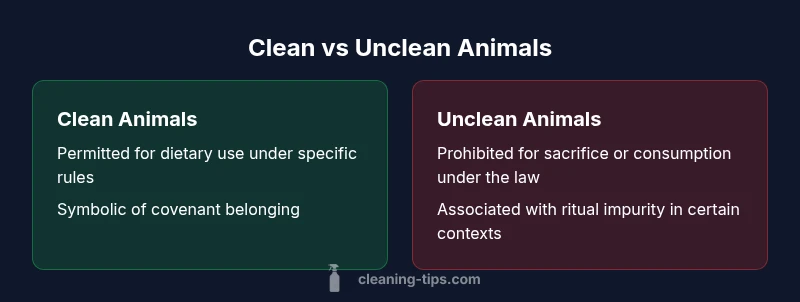
| Dietary status under ancient law | Permitted for sacrifice and dietary use under specific rules | Prohibited for sacrifice or consumption under specific rules |
| Ritual purity implications | Typically require purification when status changes | Often associated with ritual impurity and restrictions |
| Cultural role | Symbol of holiness and covenant belonging | Symbol of boundary and separation within the community |
| Symbolic meaning | Holiness, order, and obedience to divine instruction | Warning or identity marker in ritual life |
| Examples of animals commonly cited | Lamb, cattle, and fish with fins/scales (clean) | Pigs, camels, birds of prey (unclean) |
| Modern interpretive stance | Viewed as ceremonial law with covenant significance | Read as fulfilled or reinterpreted in Christian contexts; broader ethical concerns today |
Strengths
- Provides a framework to understand ancient covenant life
- Highlights how ritual boundaries shaped daily routines
- Encourages careful hermeneutics and contextual study
- Supports responsible dietary conversations in faith communities
Weaknesses
- Can be misread as moral ranking of animals
- May overemphasize literal compliance in modern contexts
- Complex scholarship can overwhelm readers
Balanced hermeneutics yields the best understanding.
The biblical categories of clean and unclean animals illuminate historical practice and theological interpretation. For modern readers, approach them with historical awareness and spiritual reflection, recognizing both covenant boundaries and evolving ethical considerations.
Questions & Answers
What counts as clean or unclean in the Bible?
The Bible classifies certain animals as clean or unclean for ritual and dietary purposes. These categories reflect ritual status within the ancient Israelite community and are described in Leviticus and Deuteronomy. Modern readers should distinguish ceremonial boundaries from moral judgments while exploring the text.
Clean versus unclean in scripture mostly refers to ritual status, not moral value; it guided worship and daily life in ancient Israel.
Do New Testament texts relax these dietary rules?
Many scholars interpret New Testament passages as relaxing or reframing dietary restrictions for Gentile believers, emphasizing spiritual purity over ritual food laws. However, interpretations vary across traditions, with some communities maintaining certain ceremonial understandings.
Some New Testament readings move beyond strict dietary rules toward broader spiritual principles.
Are these categories still relevant for Christians today?
Relevance is debated. Some traditions view the categories as ceremonial and superseded, while others see enduring hermeneutical lessons about holiness, stewardship, and community ethics. Most readers approach them as historical context that informs contemporary faith and practice.
Many Christians read these texts as historically contextual, not universal dietary commands.
How should a modern household approach these concepts?
Treat the categories primarily as historical and symbolic lessons. Focus on principles like care for creation, humane treatment of animals, and hospitality, while using scholarly and faith-community guidance to interpret scripture for current life.
Use the ideas behind purity and boundaries to guide today’s ethics and daily choices.
What is the difference between ritual impurity and moral sin?
Ritual impurity is a ceremonial state affecting participation in worship, not a judgment about moral character. Moral sin concerns ethical wrongdoing. The two are distinct in biblical law, though both can have serious communal consequences depending on context.
Ritual impurity isn’t the same as moral sin; they operate in different dimensions of biblical law.
Can these categories apply to modern issues like animal welfare?
Yes, as a framework, they invite reflection on how communities treat animals, source food responsibly, and steward resources. Interpretations vary, but the broad aim is to cultivate care, justice, and reverence for life in light of biblical ethics.
The categories can inspire modern conversations about animal welfare and stewardship.
The Essentials
- Read in historical context to understand boundaries
- Recognize that ‘clean’ and ‘unclean’ are ritual, not moral, categories
- Consider both ceremonial and symbolic meanings when reading the Bible
- Apply hermeneutics to interpret these concepts for contemporary life
- Acknowledge diverse interpretations across faith traditions